
Action Camera Buying Guide: How to Choose the Right One
Choosing an action camera can quickly become a real headache. Between the promises of 8K resolution, stabilisation systems with intimidating names, and endless lists of accessories, it's easy to get lost or make a poor investment. As a product expert at Joybuy, my role is to help you see things more clearly: to decode the marketing jargon and guide you to the model that truly fits your needs—and your budget.
Before diving in headfirst, let's break down two common and costly mistakes buyers make:
- The Low-Cost 4K Mirage: Many entry-level models proudly display "4K" compatibility. Be careful, as this is often an interpolated (or upscaled) resolution, where a low-quality sensor simply stretches the image artificially. The result? A muddy, pixelated video that's light-years away from true native 4K capture. The sensor size and bitrate (in Mbps) are far more reliable indicators of actual quality.
- The Promise of Stabilisation That Doesn't Stabilise:Image stabilisation (EIS) is crucial for a sports camera. The problem is that low-end systems often generate a very unpleasant "floating" effect or crop the image so aggressively that you lose a significant part of your field of view. A 6-axis gyroscopic stabilisation or, even better, mechanical stabilisation (a gimbal) delivers results on a whole other level.
The 3 Technical Criteria That Truly Make a Difference
To avoid falling into the trap, here are the three points to scrutinise before you pull out your credit card.
1. Image Stabilisation: The Non-Negotiable Criterion
Let's be clear: a shaky video is a useless video. This is the most important point. There are two main technologies:
- Electronic Image Stabilisation (EIS): The camera's software analyses movement via a gyroscope and compensates for shakes by slightly cropping the image. The most advanced systems, like DJI's RockSteady or Insta360's FlowState, are impressively effective, even on a motorcycle camera or when mountain biking.
- Mechanical Stabilisation (Gimbal): Here, the sensor is mounted on tiny motors that physically absorb shocks. This is the gold standard for a smooth, cinematic look, ideal for a vlogging camera when filming yourself while walking.
2. The Sensor/Resolution Duo: The Secret to a Great Image
Don't be mesmerised by the pixel count. A large sensor (e.g., 1/1.3-inch or 1-inch) captures much more light. In practical terms, this means better performance in low-light conditions, more accurate colours, and better contrast management (dynamic range). A 4K sports camera with a good sensor will always produce a better image than an 8K camera with a tiny sensor. Also, remember to check the maximum bitrate: the higher it is, the more detailed the image.
3. Ergonomics and Ecosystem: A Camera That Fits You
Your camera should adapt to your activities, not the other way around.
- Classic Action Camera: Versatile, rugged, ideal for sports and adventure.
- Mini Camera: Ultra-compact and lightweight, it mounts anywhere for unique perspectives.
- 360 Camera: It films everything around it, allowing you to choose the viewing angle after recording. This is a major asset for sports where you can't focus on framing.
- Gimbal Camera: Perfect as a travel compact camera or for vlogging, it offers unparalleled mechanical stability.
Finally, don't overlook battery life, the quality of the mobile app for editing, and native waterproofing (without a case) if you're into water sports.
Our Action Camera Recommendations
To move from theory to practice, here are a few models that tick all the right boxes for specific use cases.
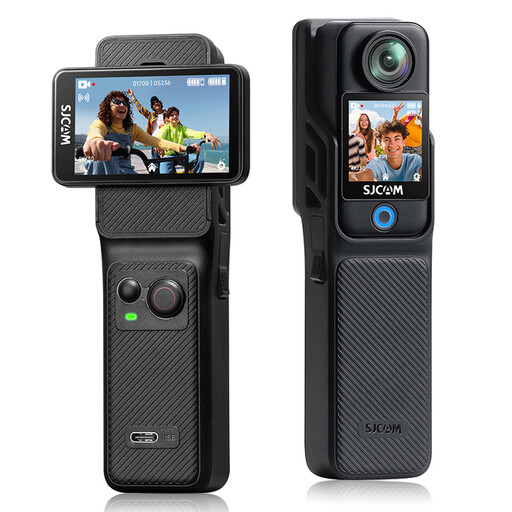
SJCAM C400 4K Action Camera with 6-Axis EIS Dual Touchscreens
Why we recommend it: Ideal for getting started with action video without breaking the bank. It offers a very comprehensive feature set for its price, with true 4K, handy dual touchscreens for self-filming, and a waterproof case for aquatic activities.
This model delivers the essentials: true 4K at 30 fps and a solid 6-axis gyroscopic stabilisation. This helps you avoid the disappointment of fake 4K and gimmicky stabilisation systems.
Unbeatable value for money. The battery life is excellent with the battery grip, and the dual screen is a real bonus for getting into vlogging.
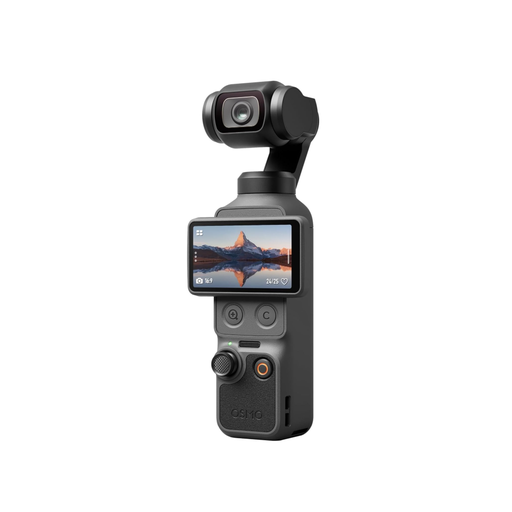
DJI Osmo Pocket 4 Standard Combo Pocket Gimbal Camera
Why we recommend it: Tailor-made for vlogging and on-the-go content creation. Its pocket-sized format and 3-axis mechanical stabilisation make it the perfect ally for pro-level smooth motion shots, without being weighed down by heavy gear.
It tackles the problem at its root by integrating a true mechanical gimbal. The icing on the cake is its large 1-inch CMOS sensor, which ensures superb image quality that goes far beyond the simple numbers on a spec sheet.
Stunning mechanical stabilisation for perfect smoothness. Excellent low-light image quality thanks to the large sensor. Ultra-portable and discreet format.
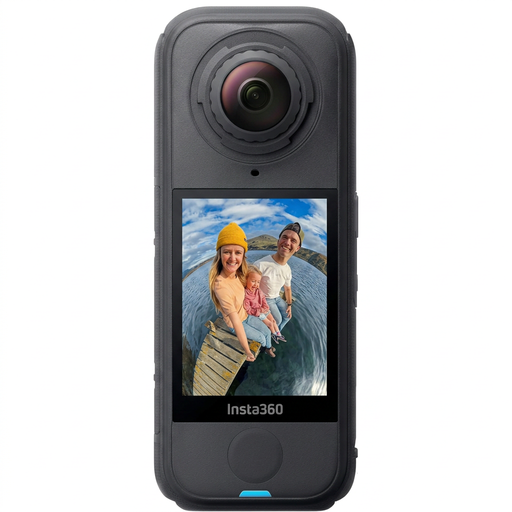
Insta360 X4 Air - Lightweight 165g 8K 360 Camera
Why we recommend it: This 360 camera changes the game. It films absolutely everything around it in 8K, completely freeing you from the constraints of framing during the action. It's the ultimate weapon for sports like skiing, surfing, or motorbiking, where you can calmly choose your angles in post-production.
It solves the fundamental problem of "missing the action." By filming in 360°, it's impossible to miss the key moment. Its FlowState stabilisation is a market benchmark, far more effective than classic EIS systems.
8K 360° capture for total creative freedom. Stunning "invisible selfie stick" effect. The famous "shoot first, frame later" workflow.
Want to see more options?
We have curated a complete selection of products that meet our demanding specifications and safety standards.
Frequently Asked Questions
What is the battery life of an action camera?
Battery life ranges from 60 to over 140 minutes of continuous recording. It heavily depends on the resolution (4K is power-hungry), the outside temperature (cold reduces it), and whether Wi-Fi is enabled. For long outings, always plan to have one or two spare batteries.
Is 4K really essential?
For viewing on a smartphone or quick sharing on social media, a 1080p resolution is often sufficient and produces smaller files. That said, 4K offers unparalleled flexibility in editing: you can zoom and reframe within the image without any visible loss of quality. It's also a way to future-proof your memories with a quality standard that's here to stay.
Is a 360 camera complicated to use?
The concept might seem intimidating, but modern apps, like the one from Insta360, have made the editing process incredibly intuitive. The "shoot first, frame later" principle even simplifies filming, as you no longer have to worry about framing in the heat of the moment. A few clicks in the app are all it takes to export a standard video from your 360° footage.