
Battery Jump Starter: A Buyer's Guide to Avoid Getting Stranded
A dead battery: every driver's nightmare, especially when you're in a hurry. The battery booster, also known as a jump starter, is the ultimate portable solution for restarting your vehicle independently. The problem? The market is flooded with models making often misleading marketing claims. As our editorial team's product expert, my mission is to help you sort through the genuinely useful features and the marketing jargon to make a smart, long-lasting purchase.
Before you buy, let's break down the two most common pitfalls that can make a jump starter not only ineffective but also dangerous:
- The Myth of Peak Amps: Many manufacturers highlight astronomical figures (e.g., 4000A). This value only corresponds to an ultra-short burst of energy and in no way reflects the device's true starting capability. The only figure that matters is the Cranking Amps (CA), which is often much less prominent and measures the real power available to start the engine.
- The Quality of Clamps and Safety Features: Low-quality clamps, brittle plastic, or undersized cables can not only fail quickly but also cause a short circuit or overheating. Likewise, the absence of essential electronic safeguards (against reverse polarity, overcharging, etc.) turns a handy tool into a threat to your car's onboard electronics.
Decoding the Spec Sheet: What Really Matters
To make the right choice, focus on a handful of non-negotiable technical criteria. This ensures you get a device that is both safe and suitable for your vehicle.
Starting Current and Engine Compatibility
Ignore the prominently displayed peak amperage and look for the manufacturer's recommended engine compatibility (e.g., "for petrol engines up to 8.0L and diesel up to 6.0L"). This is by far the most reliable indicator. A diesel engine, for example, requires a much higher starting current than a petrol engine of equivalent size. The internal battery capacity, expressed in milliampere-hours (mAh), is also a good clue: the higher it is, the more starting attempts you'll have or the more reserve power you'll get for using it as a car power bank to charge your portable devices.
Essential Safety and Maintenance Features
A good jump starter must include several safety features. Check for protection against reverse polarity, short circuits, overheating, and overcharging. These safeguards prevent the most common user errors and protect both the jump starter and the vehicle's electronics.
For more in-depth maintenance, dedicated devices like a battery maintainer or a car battery charger with a pulse repair function are more suitable. These tools aren't designed for emergency starts but to restore and preserve your battery's health over the long term—a task a standard jump starter doesn't perform. A battery tester is also an excellent companion for diagnosing your battery's health before a critical failure.
Our Recommendations Based on Your Needs
Instead of an endless list, here is a selection of products that meet specific needs, always keeping our performance and safety criteria in mind.
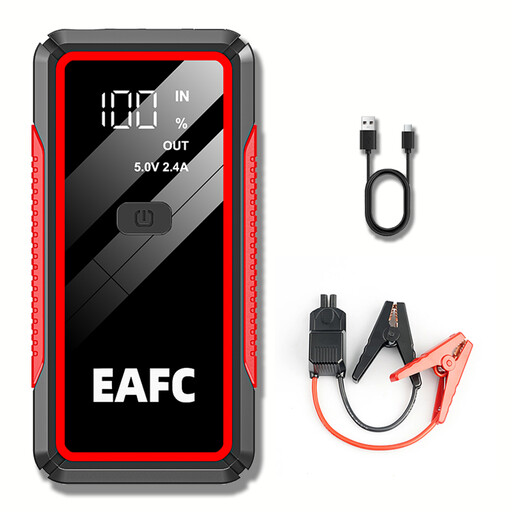
EAFC 2000A Car Jump Starter 12V - 10000mAh Portable Emergency Power Supply
Why we recommend it: Perfect for drivers of city cars, sedans, or small SUVs. Its compact size slips easily into the glove box while delivering enough power for most medium-sized petrol and diesel engines. It's the quintessential balanced and affordable emergency solution.
This model clearly states its compatibility (petrol engines up to 6.0L, diesel up to 4.0L) instead of relying solely on peak amperage. Its smart clamps incorporate all the essential safety features.
An excellent power-to-size ratio. Its 10,000 mAh capacity and USB port also make it a very handy external battery (*power bank*) for daily use.
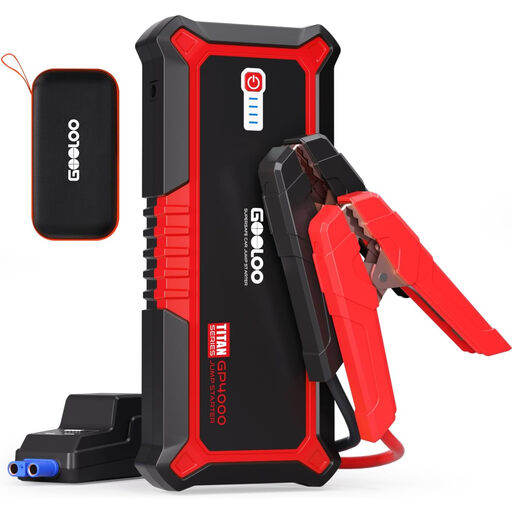
GOOLOO GP4000 Jump Starter Power Bank, 4000 A
Why we recommend it: Built for large SUVs, vans, RVs, or boats. Its colossal starting power is essential for large-displacement engines, especially the more demanding diesel ones. Its rugged design is built for heavy-duty use.
The 4000A rating here is justified by its very broad compatibility (all petrol engines, diesel up to 10.0L). It is equipped with solid metal clamps and a "BOOST" mode to force a start on completely dead batteries—a highly valuable advanced safety feature.
Serious firepower that ensures maximum versatility. Its ability to start engines up to 10.0L makes it compatible with almost all passenger vehicles and light-duty vans.
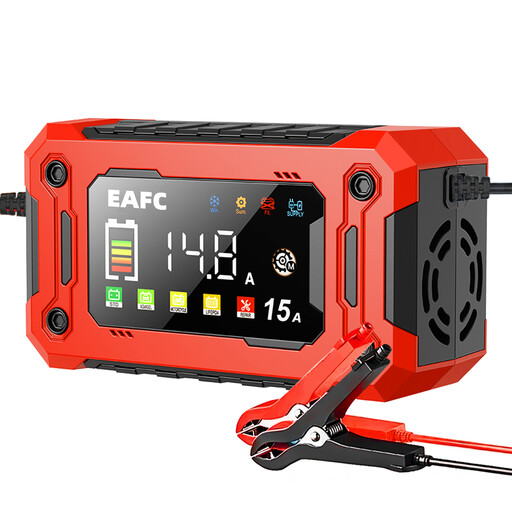
EAFC 12V 15A Car Battery Charger Large Screen Pluse Repair Charger
Why we recommend it: For those who believe prevention is better than cure. Note: this is not a jump starter, but a smart charger designed to maintain, recharge, and even attempt to recondition tired batteries. Ideal for vehicles that are driven infrequently or for prepping your battery before winter.
Its mission is not an emergency start. Its purpose is to extend the battery's lifespan through controlled charging and a pulse repair function that combats sulfation (the number one enemy of lead-acid batteries).
Smart Maintenance. Its seasonal modes (summer/winter) adapt the charging voltage for optimal efficiency, while its digital screen displays clear information about the battery's status.
Need Even More Options?
Discover our full selection of products that meet our selection criteria and current safety standards.
Battery Jump Starter: Frequently Asked Questions
What power level should I choose for a battery jump starter?
The power should be matched to your vehicle's engine. For a city car or petrol sedan, a model compatible with up to 5.0L or 6.0L is more than enough. For large SUVs, vans, or diesel engines (which require more power to start), aim for models compatible with engine sizes of 7.0L, 8.0L, and larger. Always rely on the compatibility in litres (L) specified by the manufacturer, not the peak amperage (A).
Can you leave a battery jump starter in your car permanently?
Yes, that's the whole point! It's made to be kept in your car for emergencies. Most models are designed to withstand the temperature fluctuations inside a car (typically from -10°C to +60°C). However, remember to check its charge level every 2 to 3 months and recharge it as needed so it's ready to go when you need it. Just avoid leaving it in direct sunlight behind the windscreen in the middle of summer.
What is the difference between a jump starter and a battery charger?
A battery booster (or jump starter) is a portable battery that delivers a powerful burst of current over a very short time. Its sole purpose is to help you out in an emergency to start an engine with a dead battery. In contrast, a car battery charger plugs into a wall outlet. Its job is to slowly recharge a dead battery or maintain its optimal charge level over a long period (during winter storage, for example). The most sophisticated models include a pulse repair mode to attempt to recondition sulfated batteries.