
Car LED Bulb Buyer’s Guide: How to Choose the Right One
Upgrading to LED lighting for your car holds a tempting promise: brighter light, a modernised look, and reduced energy consumption. However, the market is a minefield, saturated with promises that aren't always kept. A poor choice can quickly turn into a nightmare, resulting in dashboard error messages, a ridiculously short lifespan, or worse, dangerous lighting. As a product expert at Joybuy, my mission is to help you see things more clearly. Follow this guide to avoid the pitfalls and find the perfect LED bulb for your vehicle.
The 3 Pitfalls to Avoid When Buying an LED Bulb
Before you pull out your credit card, watch out for these common mistakes that can turn a simple upgrade into a real headache.
- The Myth of the Universal "Error-Free Canbus": Many budget-friendly bulbs claim to be Canbus compatible but prove ineffective on modern European vehicles. Your car's Canbus system monitors the electrical consumption of the bulbs. Since a car LED bulb uses much less power than a halogen, the onboard computer interprets this low consumption as a fault and triggers an alert. A true error-free Canbus LED system integrates a quality resistor or decoder to simulate the original load and trick the onboard computer.
- Confusing Brightness with Colour: Sellers often highlight dazzling lumen figures that in no way guarantee good on-road performance. More importantly, the colour temperature, measured in Kelvin (K), is often misinterpreted. A 6000K xenon white provides a pure, white light, but low-quality products can shift to a tacky 'tuner' blue that reduces visibility and may attract the attention of law enforcement.
- Poor Heat Management: This is the killer feature of LEDs: their longevity. But be warned, it depends entirely on heat dissipation. A bulb without a quality aluminium body or a cooling system (a fan for high-power models) will overheat quickly. The result? A drastic drop in brightness, flickering, and a lifespan barely better than a simple halogen bulb.
Technical Criteria to Check Before Any Purchase
To avoid buying blind, here are the three technical points you absolutely must verify.
1. The Base: The Foundation of Compatibility
It's the absolute basics, but a mistake is easily made. Each location on your vehicle (headlights, dome light, number plate) uses a specific type of base. If the base doesn't match, the bulb is useless.
- For interior, sidelights, and number plate LEDs: The most common bases are T10 (also known as W5W). They are small, easy to install, and very versatile.
- For headlights and fog lights: Bases like H1, H4, H7, H8/H9/H11 are standard. A car LED kit for the main headlights must perfectly match the original base to ensure a precise and safe beam pattern.
Pro Tip: The safest method is to consult your vehicle's manual or, even better, remove the original bulb to read the reference number on it before ordering.
2. Canbus Compatibility: Peace of Mind
As we've seen, if your car was made after 2005, it's highly likely to be equipped with a Canbus system. To avoid dashboard alerts, you must opt for bulbs marked "Canbus Ready" or "Error Free", which have integrated circuits designed to communicate with these systems.
3. Colour and Beam Pattern: See and Be Seen
- Colour Temperature (Kelvin): For a modern look and excellent contrast perception, a temperature of 6000K to 6500K is ideal. This is the famous xenon white or cool white tint. More bluish tints (above 7000K) should be avoided, as they degrade visibility, especially in rainy weather.
- Beam Pattern: For a car LED headlight or LED fog light, the bulb's geometry is crucial. A good model must perfectly replicate the focal point of the original halogen bulb to project light onto the road, not dazzle oncoming drivers. Models with a "1:1 design" are a safe bet for this.
Our Top LED Bulb Picks
To help you make your choice, here are a few products that tick all the boxes, each meeting a specific need.
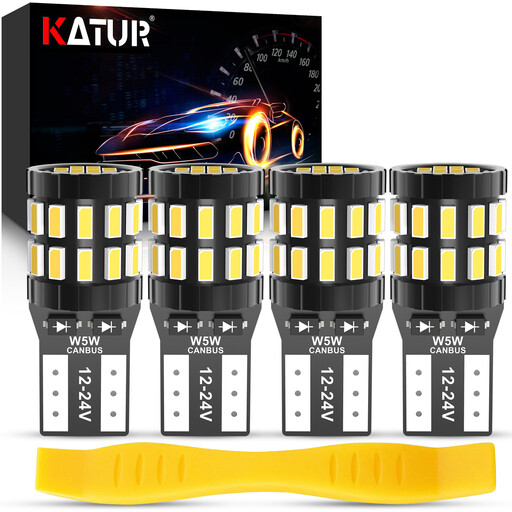
KATUR 194 T10 W5W 501 168 Super Bright LED Bulb 6000K Xenon White
The verdict: Ideal for giving a modern touch to interior lighting (dome light, glove box) or exterior lighting (number plate, sidelights) without any hassle. A simple, effective, and perfect upgrade for daily use.
This model includes effective error-free Canbus LED compatibility for the majority of vehicles, saving you from unwanted alerts. Its 6000K xenon white colour is accurate, providing a truly white light, not a bluish one.
"Plug and Play" installation that takes just a few minutes. Its great versatility comes from its standard t10 led bulb / w5w led base.
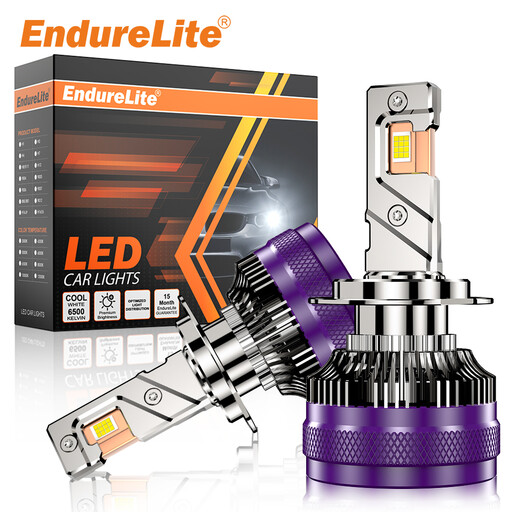
EndureLite 9006 LED Bulbs, 6000K Cool White
The verdict: The sensible choice for those who want a radical improvement in the visibility of their headlights or fog lights. The superior power allows you to see further and better anticipate hazards.
This car LED kit features active cooling (a fan) that neutralises the risk of overheating. The result: stable performance and maximum longevity, even at full power.
A beam pattern designed to illuminate further and wider, without ever dazzling others. Its Canbus compatibility is nearly universal (99% of vehicles) for a hassle-free installation.
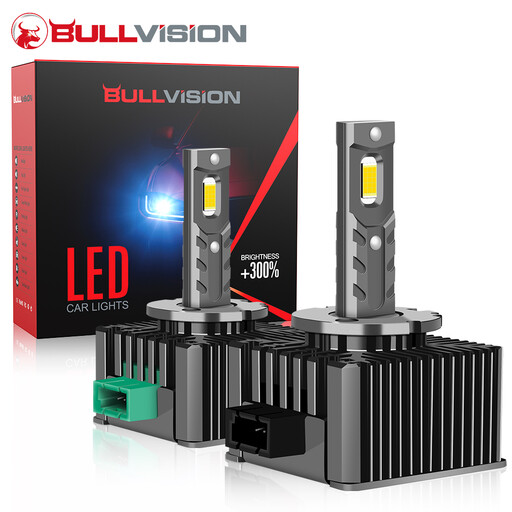
Bullvision D4S/R D1S/R D3S/R D2S/R 110W 6000K LED Bulbs
The verdict: The dream solution for owners of vehicles already equipped with factory Xenon (HID) who want to switch to LED without any modifications. Its 1:1 design makes replacement as simple as changing a standard bulb.
Its "Perfect Beam Pattern" design flawlessly replicates the original beam, eliminating the risk of glare. The integrated smart driver ensures seamless Canbus compatibility for a zero-fault transition.
Direct "Plug and Play" installation in place of D1/D2/D3/D4 Xenon bulbs. The fan-based cooling system is a guarantee of rock-solid durability.
Haven't found what you're looking for?
We have selected a complete range of products that meet our quality criteria and regulations.
Frequently Asked Questions
Are LED car bulbs legal?
Regulations are a major topic. For interior, boot, or number plate lighting, the use of LEDs is widely tolerated. However, for headlights (low beam, high beam) and fog lights, it's stricter. To be 100% compliant, your car LED kit must have an ECE approval specific to your vehicle model. Without it, its use is theoretically restricted to off-road or track use. A word of advice: always check the current legislation and product certifications before purchasing.
Will I get an error message on my dashboard?
This is the main risk with modern cars. To avoid it, it's crucial to choose a quality car LED bulb explicitly designed with an error-free Canbus LED system. These models include electronics that communicate correctly with the onboard computer, eliminating 99% of error messages.
Is the lifespan of an LED bulb really longer?
Yes, by far, but on one condition: the heat must be perfectly dissipated. A standard halogen lasts about 1,000 hours; a quality LED can exceed 30,000 hours. But this promise only holds if the bulb has an efficient cooling system (aerospace-grade aluminium body, fins, etc.) or a fan for the most powerful car headlight LED models. A poorly cooled, low-end product will see its performance and lifespan drop drastically.