
Car LED Kits: A Guide to Choosing Wisely and Avoiding Pitfalls
Replacing your halogen bulbs with a car LED kit is an idea that appeals to more and more drivers. The promise is tempting?: better night-time visibility, reduced energy consumption, and an instantly modernised look. The problem is, the market is flooded with a myriad of options and marketing promises that too often lead to buyer's remorse. A poor choice isn't just money down the drain?: it's a potential risk to your safety and the safety of others.
Before taking the plunge, it's crucial to know the three most common pitfalls to avoid?:
- The lumen race, a number that doesn't tell the whole story?: Many manufacturers bombard buyers with astronomical brightness figures. But a powerful car LED bulb is about more than just lumens. A poorly designed beam, even an ultra-powerful one, will only dazzle other drivers and create dangerous blind spots, paradoxically reducing your own visibility.
- The myth of universal "Plug and Play"?: The "3-minute flat" installation claim is a marketing classic, but the reality is often more complex. Some kits require specific adapters, modification of the headlight dust cover, or are simply too bulky to fit into tight headlight housings.
- Overheating, the sworn enemy of longevity?: An LED bulb gets hot. Very hot. Without an effective cooling system (fan or passive heat sink), the LED chip degrades at an alarming rate, leading to a dramatic loss of brightness or even complete failure in just a few months.
Technical Criteria You Should Never Overlook
To make an informed choice, forget the marketing slogans and focus on objective criteria. Here are the three non-negotiable points to check before choosing your LED conversion kit.
1. The Bulb Base: The Essential Starting Point
This is THE foundation. The absolute starting point. Each light on a vehicle (low beams, high beams, fog lights) uses a specific type of bulb, identified by a code: the "base" or "fitting". The most common are:
- H7 LED Bulb?: Generally used for low or high beams in separate headlight units.
- H4 LED Bulb?: A dual-filament bulb that handles both low and high beams in a single bulb.
- H1, H11, HIR2 LED Bulbs?: Other common standards for main headlights or fog lights.
- W5W LED Bulb (or T10)?: Used for parking lights, number plate lights, dome lights, or courtesy lights.
The best course of action? Consult your vehicle's manual or, even simpler, remove the original bulb to identify the base. It's a simple step that will save you the hassle of a product return.
2. The Cooling System: Fan or Fanless?
Thermal management is the name of the game: it directly determines the lifespan of your car's LED headlight. Two technologies compete:
- Active Cooling (Fan-Cooled)?: An integrated mini-fan dissipates the heat. This solution allows for very high light outputs while maintaining stable performance. The downside: the fan is a mechanical part that can fail and may produce a slight whining sound.
- Passive Cooling (Fanless)?: Heat is dissipated via an aluminium heat sink, often in the form of braided metal straps or fins. These models are, by definition, completely silent, more compact, and have no moving parts that can wear out. In return, their light output is generally more moderate to keep temperatures under control.
The choice will therefore depend on the space available in your headlight housing and your priorities: maximum performance or rock-solid reliability.
3. Electronic Compatibility: The Canbus Challenge (OBC Error-Free)
Modern cars are equipped with an on-board computer (OBC) that constantly monitors the proper functioning of all components, including the bulbs. A standard halogen bulb has a certain electrical resistance. An LED bulb, being much more energy-efficient, consumes so little that the OBC might think the bulb is burnt out... and trigger an alert on your dashboard.
This is where the OBC error-free LED bulb (often labelled "Canbus Ready") comes in. It integrates a resistor or a dedicated circuit to "trick" the on-board computer by simulating the consumption of a halogen bulb, thus preventing unwanted alerts. For most European vehicles produced after 2005, this feature is simply essential.
Top LED Kits to Consider
Rather than crowning a single winner, we have selected the ideal product for each type of user.
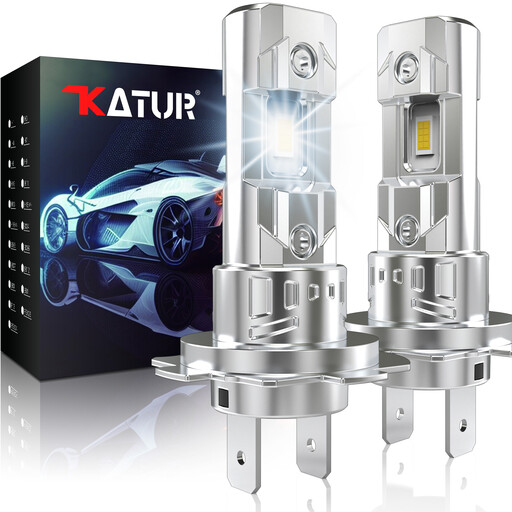
KATUR H7 LED Bulbs 26000LM 80W (Fanless)
Why it's a great choice: Perfect for those who want to replace their halogen bulbs with a simple and reliable LED solution. The focus here is on ease of installation and durability, free from the constraints of a fan. It's the sensible choice for a noticeable improvement in daily visibility.
Its fanless design eliminates any risk of mechanical failure and all noise. Its ultra-compact "1:1" size makes the "Plug and Play" promise finally credible, even in the tightest headlight housings.
Total silence in operation and a greatly simplified installation thanks to its compact size. The ideal solution for switching to an H7 LED bulb without worrying about the bulk of a fan.
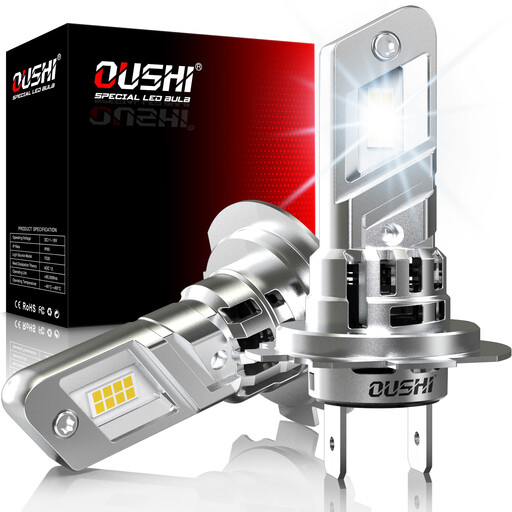
OUSHI High-Power H7 LED Bulbs, 6500K Xenon White
Why it's a great choice: Designed for drivers who clock up the miles on poorly lit country roads and for whom safety is paramount. This kit focuses on raw light output for maximum beam range and width, allowing you to see obstacles from a long, long way off.
Such a massive power output would be a one-way ticket to overheating without flawless thermal management. This model therefore includes a high-speed turbo fan to actively dissipate heat, an absolute must for protecting the LED chips from premature degradation.
Phenomenal lighting power for uncompromised visibility. The Canbus system, advertised as compatible with 98% of vehicles, is a major selling point for such a powerful car LED bulb.
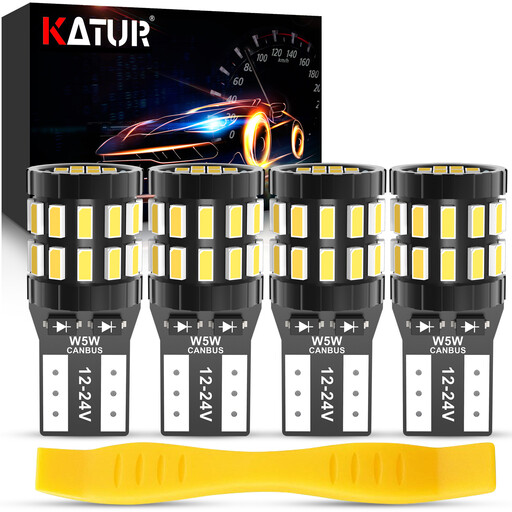
KATUR T10 W5W LED Bulbs, 6000K Xenon White Error-Free
Why it's a great choice: For the driver who isn't satisfied with just headlights and aims for a complete aesthetic upgrade. These W5W LED bulbs are perfect for matching the interior lighting (dome lights, glove box), parking lights, and number plate with the pure, white light of the new headlights.
The number one pitfall with these small bulbs? The on-board computer error. This model is clearly labelled "Canbus Error Free", a knockout argument to reassure owners of modern vehicles about electronic compatibility.
Versatility and aesthetic consistency. They allow for a full LED conversion across the entire vehicle, with an extremely simple installation and electronic compatibility designed for modern cars.
Looking for other models?
We have put together a complete and up-to-date selection of LED kits that meet our selection criteria and regulations.
Frequently Asked Questions about LED Kits
Are LED conversion kits road-legal in France?
This is the sensitive point. In France, regulations are strict: for a headlight to be compliant, the entire "housing + light source" assembly must be type-approved. Replacing a halogen bulb with an LED in a headlight not designed for it de facto modifies this assembly. In theory, most LED conversion kits are therefore reserved for off-road use. In practice, it is imperative to choose kits that perfectly replicate the original beam pattern to avoid dazzling others, and to stay informed of developments, as some manufacturers are developing road-legal solutions.
Is an "OBC error-free" bulb an absolute guarantee against dashboard warnings?
It's an excellent guarantee, but not foolproof. Manufacturers often claim 98% or 99% compatibility. Some vehicles, particularly from premium German brands, have such sensitive diagnostic systems that they can still detect the difference and display an error. In these rare cases, adding an external Canbus module (a small additional resistor) usually solves the problem.
So, with or without a fan: how to choose?
- Opt for a kit with a fan if light output is your number one criterion and the space in your headlight housing allows for it. This is the performance choice, especially for the most powerful H4 or H7 LED bulbs.
- Opt for a fanless (passive) kit if you prioritise reliability (zero moving parts), absolute silence, and if your headlight housing is particularly tight. This is the peace-of-mind solution—robust and durable, for a performance gain that is already very significant compared to halogen.