
Clocks and alarm clocks: how to choose a reliable, easy-to-read model suited to your home
A clock or alarm clock should not be chosen based on appearance alone. A wall clock may look stylish but be impossible to read from the other side of the room. Conversely, a luminous alarm clock can turn the bedroom into a night light if its display remains too bright during the night. The features highlighted in product descriptions also deserve careful consideration.
Here are the main pitfalls to avoid and the criteria to compare before buying a wall clock, digital alarm clock or digital clock.
Common pitfalls before buying
1. Confusing a silent mechanism with complete silence
The term ‘silent’ may simply refer to a continuous movement. However, not all mechanisms behave in the same way. A clock with a ticking movement may produce a faint, regular sound that is perfectly audible in a bedroom or quiet office.
When choosing a silent clock, look for precise information about the type of movement. A ‘sweep’ mechanism, in other words a continuous movement, is generally associated with a smoother and quieter second hand. Take the time to check the manufacturer’s information rather than relying solely on the photos.
2. Underestimating readability
A beautiful decorative clock is not necessarily practical for everyday use. Numbers that are too thin, insufficient contrast or a cluttered dial can make it difficult to read the time from a sofa, worktop or bed.
Before placing your order, compare the dial diameter, the height of the numbers and the distance from which you intend to read the time. In a large room, a 47 to 70 cm model will often be more suitable than a small clock.
3. Overlooking power requirements and installation
Some clocks run on a single AA battery, while others require several batteries or plug into the mains. A morning alarm clock with lighting, a radio or a USB-C port may need a nearby socket.
Also check whether batteries and the mains adapter are included. For wall installation, the weight, wall type and mounting system are crucial. A heavy clock or one with a glass front must be secured using fittings suitable for the surface.
Essential criteria when comparing a clock and an alarm clock
Analogue or digital display
An analogue clock will sit perfectly in a classic, vintage or industrial interior. Its hands and numbers also make it a genuine decorative feature, like a vintage clock decorated with a world map or made from a metal structure.
A digital wall clock or digital alarm clock focuses above all on immediate readability. Large, high-contrast numbers are particularly practical in a kitchen, workshop, classroom or bedroom where you want to check the time without getting closer.
The features that are genuinely useful
Start by identifying your needs before being won over by the options:
- Clock with alarm for waking up every day or setting two different times.
- Alarm clock with projection to display the time on the ceiling or wall from your bed.
- Luminous alarm clock with adjustable brightness to reduce disturbance during the night.
- Calendar or date display, useful in an office as well as in a kitchen.
- Clock with thermometer to monitor the room temperature.
- FM radio, nature sounds or a USB-C port to combine several uses in a single device.
- Table stand and wall mounting to change the clock’s position easily.
Additional features are only worthwhile if they remain simple to use. Clear instructions, accessible buttons and settings memory may prove more valuable than an endless list of options.
Materials, dimensions and placement
Plastic is lightweight and generally easy to install. Metal or a wood-effect structure adds more character, but may also make the whole clock heavier. A glass front can enhance the premium look, at the cost of taking extra care during installation and cleaning.
In a bedroom, choose an adjustable display and a discreet mechanism. In the lounge, diameter and style may take priority. On a desk, a compact, adjustable and easy-to-read desk clock will often be the most practical solution. In a child’s bedroom, keep small parts out of reach and make sure the batteries cannot be accessed.
For electronic devices, check that the relevant regulatory information and safety instructions are provided, and that the power supply is compatible. Where applicable, the CE marking must be indicated by the manufacturer or seller.
Our selection based on your needs
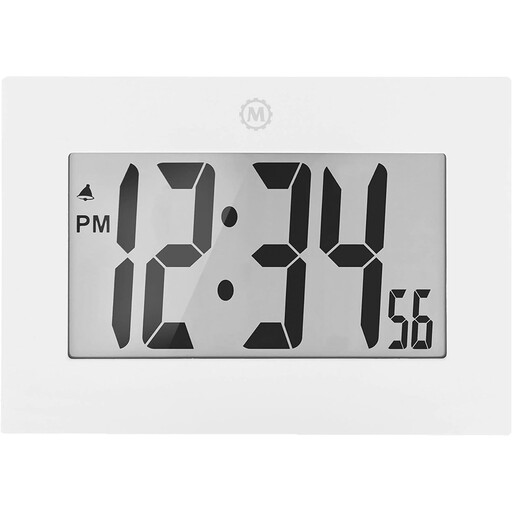
Marathon Calgary digital wall clock – white
Why this choice suits this profile : Its LCD display with large numbers is ideal for anyone looking for a simple, easy-to-read clock that can be wall-mounted or placed on a desk.
Its dimensions of 22.8 × 8.9 × 2.5 cm are clearly stated, and the two AA batteries are included. There is no need to buy anything else immediately.
Alarm with snooze function, fold-out stand and provision for wall mounting.
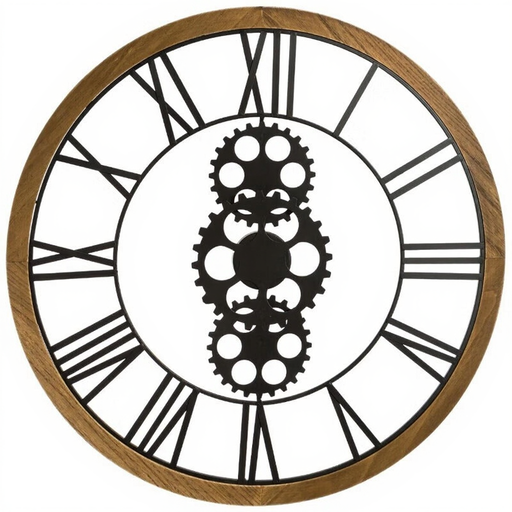
Atmosphera Maelo, 70 cm metal clock with mechanism
Why this choice suits this profile : With its 70 cm diameter, metal structure and wood-effect edging, it blends naturally into a lounge or office with retro or industrial décor.
The product description specifies that there is no backlighting and reminds you that suitable wall fixings are required for this 1.92 kg item.
Continuous movement advertised as silent, open dial and visible gears.
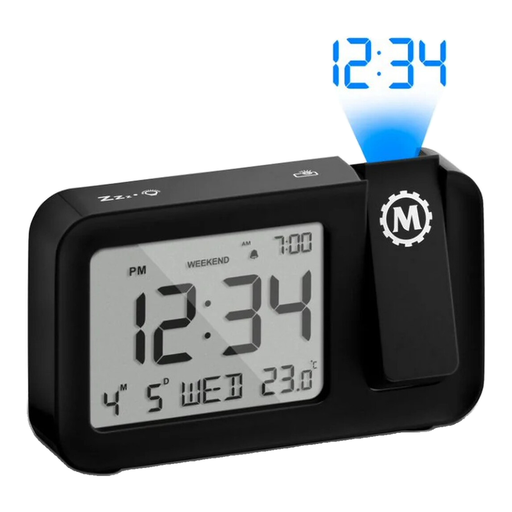
Marathon Las Vegas, digital alarm clock with projection
Why this choice suits this profile : It is designed for anyone who wants to read the time from bed and set two wake-up times.
The projection can be adjusted, while the backlight offers three brightness levels. This lets you adapt the display to the bedroom atmosphere.
Two alarms, snooze function, indoor temperature display and 12- or 24-hour formats.
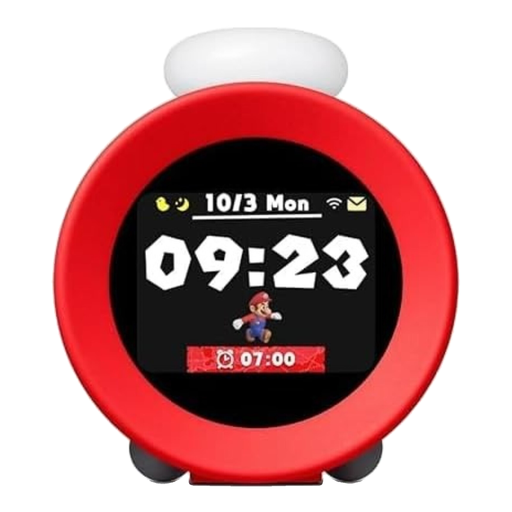
Nintendo Alarmo, interactive musical alarm clock
Why this choice suits this profile : This Nintendo alarm clock makes waking up more fun with video game sounds and motion detection, while displaying the time on a 2.8-inch LCD screen.
The product description explains the sensor positioning, USB-C or four AA battery power options, and the limitations caused by obstacles.
Motion detection, snooze function, sound scenes from several games and ‘Bedtime’ mode.
Looking for more options ?
We have brought together a complete, real-time updated selection of products that meet these demanding criteria and European safety standards.
FAQs about clocks and alarm clocks
Which clock should you choose for a quiet bedroom ?
Choose a model whose product description explicitly mentions continuous movement or a silent mechanism. Do not rely solely on the shape of the second hand. For an alarm clock, also choose adjustable brightness and a display that is discreet enough for use at night.
Does a digital clock use a lot of power ?
It depends on its power supply and the features you use. A battery-powered model is convenient when you do not want a cable running to a socket, but its battery life varies depending on the screen size and how often the batteries need replacing. An alarm clock with a radio, lighting or projection may require mains or USB power for long-lasting operation.
How do you install a wall clock safely ?
Start by checking the clock’s weight, then choose fixings suitable for your wall. On a plasterboard partition, use an appropriate wall plug. Make sure the hook or screw is properly engaged, and check that the clock is stable after installation. Glass or large-diameter models require particular care.