
Desk Buying Guide: Choosing the Right Model and Avoiding Pitfalls
Whether for remote work, studying, or a personal project, choosing a desk should not be taken lightly. It's the nerve centre of your productivity and comfort. Yet, faced with an overwhelming array of options, it's easy to be tempted by the wrong model and turn a promising purchase into a daily regret. As the Head of Product Selection at Joybuy, my mission is to help you gain some clarity and identify the essential criteria for making the right choice.
Before you dive in, let's review the most common pitfalls to avoid.
- The aesthetics-over-stability trap: A seductive design can hide a flimsy structure. Many entry-level models use low-density particleboard that can bow under the weight of a single monitor or a few books. A desk that wobbles with every keystroke is the worst enemy of your concentration.
- Sacrificing ergonomics: An improper height or insufficient legroom are flaws you often only discover with use. These details, which may seem trivial at first, can lead to poor posture and long-term pain.
- The illusion of impractical minimalism: A clean, uncluttered surface looks great in photos, but it quickly becomes an organisational nightmare without any storage solutions. The absence of drawers or shelves rapidly turns a workspace into a battlefield of piled-up documents and supplies.
Key Criteria to Check Before You Buy
To avoid these disappointments, focus on a few key points that make all the difference.
1. Dimensions and Workspace
The first step: measure the space you have available, but more importantly, define your needs.
- Width and Depth: A standard computer desk is about 120?cm wide. If you use two monitors or need space to write, a large desk of 140?cm or 160?cm will be much more comfortable. Depth is also crucial: aim for at least 60?cm to have enough distance from your screen.
- Shape: The corner desk (or L-shaped desk) is an excellent solution for optimising a corner of a room and separating your computer area from your writing space. It offers a generous work surface without encroaching on the centre of the room.
2. Materials and Load Capacity
The lifespan of your desk depends directly on the materials it's made from.
- Desktop: Veneered particleboard (MDF) is the most common and offers good value for money. Check the thickness of the top (at least 15?mm is a minimum) and the quality of the veneer. Solid wood is more premium and durable, but also more expensive and heavier.
- Frame: A steel frame, often associated with the industrial-style desk, ensures excellent stability. Check that the legs are equipped with adjustable feet to compensate for minor floor irregularities.
- Load Capacity: This figure, usually provided by the manufacturer, is an excellent indicator of sturdiness. A capacity of 50?kg is the bare minimum for typical office use.
3. Ergonomics and Practical Features
A good desk adapts to you, not the other way around.
- Height: The standard height is around 75?cm. If you are particularly tall or short, or if you want to alternate between positions, a sit-stand desk with electric adjustment is an option to seriously consider for your well-being.
- Storage: A desk with storage (drawers, cubbies, shelves) is a major asset for keeping your workspace tidy. Some models offer reversible cabinets or shelves, which can be installed on the left or right depending on your room's layout.
Desk Picks for Every Profile
To help you take action, here are a few models that meet specific needs and tick all the boxes for the criteria we've just discussed.
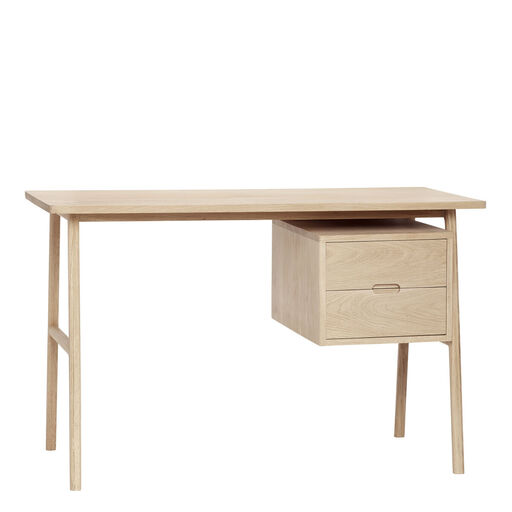
Hübsch Architect Desk Natural
Why we love it: Perfect for those seeking a designer desk with clean lines. Its Scandinavian style fits beautifully into a polished interior, without sacrificing practicality thanks to its integrated drawer.
It avoids the trap of flimsy aesthetics by relying on quality materials (FSC-certified MDF, oak veneer, and oak wood), which ensure excellent longevity.
Its elegant design and certified materials make it a durable piece of furniture that enhances the workspace.
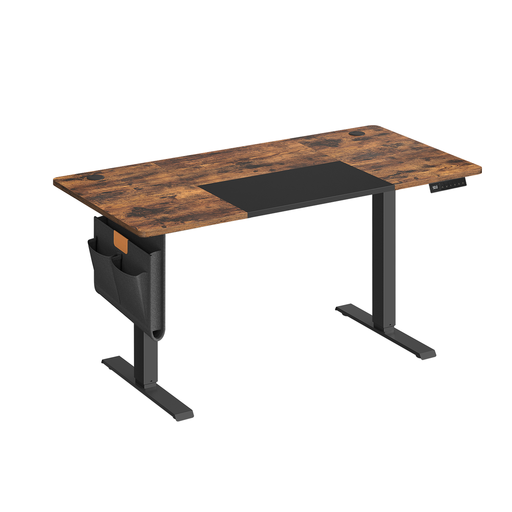
JOYFURNOS Electric Desk with 4 Memory Presets
Why we love it: Essential for long days of remote work. It allows you to easily switch between sitting and standing positions, promoting better posture and a daily boost of energy.
It directly addresses the pitfall of sacrificed ergonomics. Its motorised height adjustment (72-120 cm) and memory function allow you to find and maintain an optimal working posture effortlessly.
Its quiet motor, stable steel frame (max load: 70 kg), and thoughtful features (USB-C port, cable grommets) make it a complete and modern workstation.
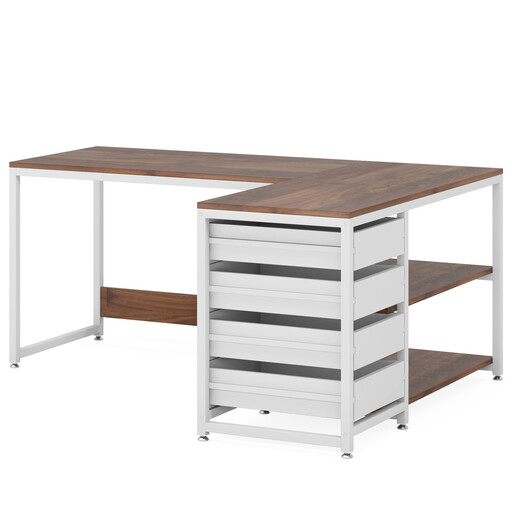
LANTINE L-Shaped Desk with 4 Drawers
Why we love it: Designed for those who juggle multiple tasks and need a large work surface with plenty of storage. Its L-shape maximises the available surface area while keeping everything within easy reach.
It tackles the trap of impractical minimalism with its 4 drawers and 2 shelves, which help keep the desktop clear. Its reversible design is a real plus for adapting it to any room.
An all-in-one solution that combines a large corner desk, a sturdy metal frame, and generous storage capacity for a perfectly optimised workspace.
Looking for other models?
We have curated a complete range of desks that meet our selection criteria and quality standards.
Frequently Asked Questions
What is the ideal height for a desk?
The standard height for a desk is about 75?cm, which suits most people of average height using an adjustable office chair. For perfect ergonomics, the golden rule is simple: your elbows should form a 90-degree angle when your forearms are resting on the desk, and your feet should be flat on the floor. If this standard height doesn't work for you, an adjustable desk is undoubtedly the best solution.
How do I maintain a wood or veneer desk?
To keep your desk looking its best, dust it regularly with a soft, dry cloth. For stains, use a slightly damp cloth and then immediately dry the surface. Above all, avoid abrasive cleaners or chemical solvents that could damage the finish. Also, consider using coasters and a mouse pad to protect the desktop from scratches and moisture rings.
Is a corner desk a good idea for a small space?
Absolutely! Contrary to popular belief, a corner desk is often a very clever solution for optimising a small space. By occupying a corner that is often unused, it frees up the rest of the room while offering a more generous work surface than a straight desk of a similar footprint. It is therefore a highly effective solution for creating a dedicated office nook in a living room or bedroom.