
How to Choose a Front and Rear Dash Cam for Complete Protection
A fender bender in a car park, a right-of-way dispute, or simply the desire to capture memories of your most beautiful drives? The front and rear dash cam has become an indispensable tool for many drivers. By simultaneously filming the road ahead and what's happening behind you, this type of in-car camera offers 360° coverage and invaluable peace of mind.
Faced with an overwhelming number of options, it's easy to get lost. This guide is here to decode the truly useful features and help you choose the model that fits your needs, without drowning you in technical jargon.
Buyer's Guide: The Essential Criteria for a Front and Rear Dash Cam
Before diving into our top picks, let's review the key technical points to check to make the right choice.
1. Image Quality: More Than Just 4K and Night Vision
A video is only valuable if details, like a license plate, are perfectly legible. While resolution is a good starting point (a 4K dash cam offers superior sharpness), it isn't everything:
- Image Sensor: Industry-leading sensors like Sony STARVIS are specially designed to excel in low light, a key advantage for a night vision dash cam.
- HDR (High Dynamic Range) Technology: This compensates for strong contrasts between dark and bright areas. It's essential for preventing an image from being "blown out" by headlights at night or when exiting a tunnel.
- Viewing Angle: A wide angle (between 130° and 150°) covers multiple lanes of traffic without creating excessive image distortion (the "fisheye" effect).
2. Parking Surveillance: The Renowned 24/7 Parking Mode
Protecting your vehicle doesn't stop when you turn off the ignition. Parking mode is a key feature for monitoring your car while it's stationary. It can be triggered in several ways:
- Impact Detection (via G-sensor): The camera wakes from standby and records a write-protected video clip as soon as an impact is detected.
- Motion Detection: More sophisticated models use AI to identify suspicious movements around the vehicle and initiate recording.
- Time-lapse Recording: The camera films continuously at a low frame rate (e.g., 1 frame/second) to condense hours of surveillance into a short video, thus optimising space on the memory card.
Important note: to use these functions, a specific wiring kit (or "hardwire kit"), often sold separately, is practically indispensable. It allows the camera to be powered continuously without the risk of draining the car's battery.
3. Connected Features: GPS, Wi-Fi, and ADAS
Far from being simple cameras, modern dash cams are packed with highly practical technologies.
- An in-car camera with built-in GPS timestamps and geotags your videos. This metadata can prove crucial in the event of a dispute.
- Wi-Fi allows you to connect the dash cam to your smartphone via a dedicated app. This lets you view recordings, download them to your phone, and adjust settings without ever having to remove the memory card.
- The ADAS (Advanced Driver Assistance Systems) adds driving aids, such as lane departure or forward collision warnings. A real bonus for everyday active safety.
Recommended Front Rear Dash Cams
After scouring dozens of spec sheets, our editorial team has selected three models that stand out for their excellent balance of features, performance, and reliability.
70mai Dash Cam A510-1: The Sensible and Balanced Choice
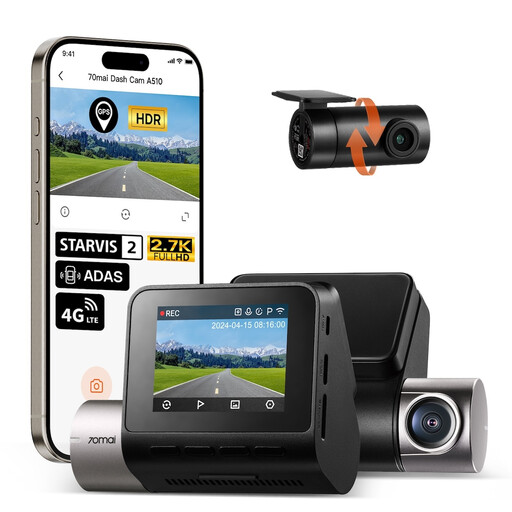
Why it stands out: This model is an excellent entry point into the world of dual-lens dash cams. It features the Sony STARVIS 2 IMX675 sensor, renowned for its low-light prowess, and supports HDR on both cameras. Its intelligent emergency lock, which pre-records the 5 seconds leading up to an impact, is a real plus for accurately reconstructing events.
Pros:
- Front/Rear Recording: 1944P front camera and 1080P rear camera, both with HDR technology.
- High-Performance Sensor: The Sony STARVIS 2 ensures a sharp image, day or night.
- Built-in GPS: Records speed and coordinates on every video.
- Stationary Security: Parking mode with collision detection and time-lapse (requires the UP04 hardwire kit).
- Driver-Assistance: ADAS system with clear voice alerts.
Who is it for? For drivers looking for a reliable and complete front and rear dash cam solution that offers excellent image quality and essential safety features, without necessarily needing absolute 4K resolution.
70mai 4K Omni X800-2: 360° Surveillance with No Blind Spots
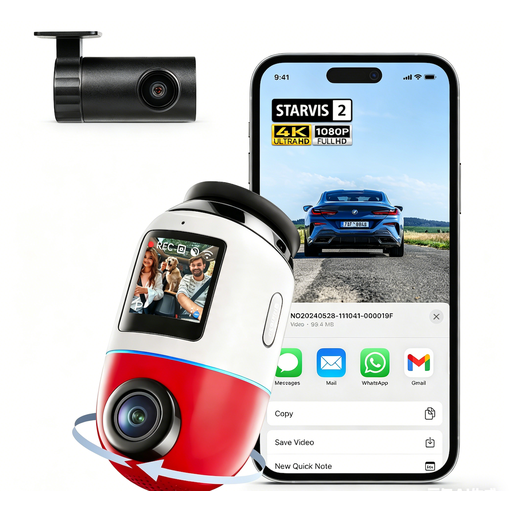
Why it stands out: The Omni X800 is one of a kind with its motorised 360° rotating head, which leaves no blind spots. It can film the road, the cabin, or even the sides of the vehicle. Paired with a 4K resolution at 60 frames per second, it captures the fastest-moving scenes with stunning smoothness and clarity. Its AI 2.0 motion detection provides remarkably precise parking surveillance.
Pros:
- Motorised Panoramic View: 360° rotation for total coverage.
- Exceptional Image Quality: True 4K 60FPS at the front and 1080P HDR at the rear, thanks to the Sony STARVIS 2 IMX678 sensor.
- Intelligent Surveillance: AI 2.0 motion detection for a state-of-the-art parking mode.
- Ultra-Fast Connectivity: Wi-Fi 6 5 GHz for near-instant file transfers.
- Remote Monitoring: 4G connectivity option for real-time tracking (requires the appropriate hardwire kit).
Who is it for? For tech enthusiasts and demanding drivers who want to make no compromises on their vehicle's surveillance. Its ability to film in 360° and its 4K 60FPS quality make it the ultimate surveillance tool.
70mai 4K Dash Cam A810-2: The 4K Night Vision Champion
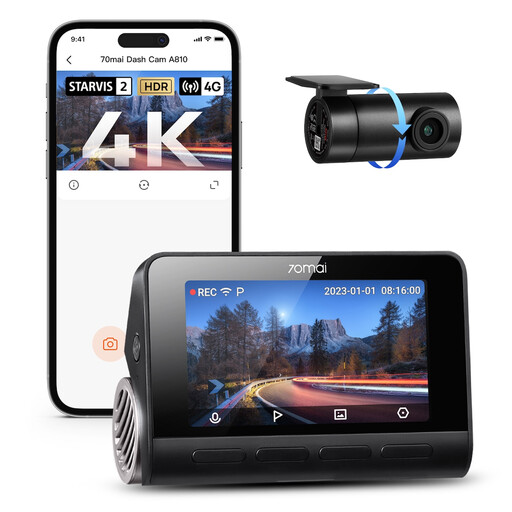
Why it stands out: This model goes all-in on uncompromised image quality. It is equipped with two Sony STARVIS 2 sensors (one front, one rear) and 70mai Night Owl Vision technology, which optimises clarity in very low light conditions. As a testament to its quality, the A810 received a "Technology Innovation Award" in 2024 and earned a "Good" rating from the highly respected German testing bodies Autobild.de and Computerbild.de.
Pros:
- Dual Sony STARVIS 2 Sensors: 4K image quality at the front and 1080P at the rear, with advanced optimisation for nighttime.
- Dual-Channel HDR Night Vision: Clear and detailed recording, even when facing dazzling headlights or in poorly lit areas.
- AI Parking Surveillance: Detects suspicious human activity and triggers simultaneous recording from both cameras.
- Voice Control: Simple commands to take a photo or lock a video without taking your hands off the wheel.
- GPS and 4G Tracking: Built-in GPS and 4G compatibility for remote monitoring (with the UP04 kit).
Who is it for? For drivers for whom night vision and the clarity of video evidence are the number one criterion. It's the top choice for those who frequently drive at night or park in poorly lit areas.
Looking for Other Options?
Does our selection not quite meet your expectations? If you want to explore other technologies, especially regarding night vision, feel free to browse our complete category. There you will discover a wide range of in-car cameras for all needs and budgets.
Discover our range of night vision car cameras
Frequently Asked Questions (FAQ)
Is a dash cam legal?
Yes, using an in-car camera is perfectly legal in France for private use. The recordings are also admissible as evidence by insurance companies or law enforcement. However, be careful: sharing these images on the Internet is strictly regulated by privacy laws. It is imperative to blur the faces and license plates of third parties.
Will parking mode drain my car's battery?
Parking mode is designed for very low power consumption. Furthermore, the hardwire kits recommended for this function include a protection feature that automatically cuts power to the dash cam if your car's battery voltage drops below a certain threshold. This ensures you can start your car without any issues.
Is 4K resolution really necessary?
4K resolution offers a level of detail that can make all the difference when trying to read a license plate from a distance or in difficult lighting conditions. However, a good 2K (1944P) or even 1080P resolution, when paired with a quality sensor and HDR technology, already provides perfectly clear and usable images. The choice will depend on your standards and your budget, keeping in mind that 4K files are larger and require a higher-capacity memory card.