
H7 LED Car Bulbs: How to Choose Compatible Lighting and Avoid Nasty Surprises
Replacing halogen bulbs with H7 LED car bulbs often gives you a whiter light and instant illumination. But a product listing that promises 20,000 or 30,000 lumens doesn’t guarantee a properly shaped beam or perfect compatibility with your vehicle.
Before you place an order, check the bulb reference, the space available inside the headlight unit, and how your car’s electronic system handles this new light source. These precautions apply just as much to cars as they do to SUVs, vans, motorbikes and leisure vehicles.
Common Pitfalls with H7 LED Bulbs
1. Relying Only on the Lumen Count
Product listings sometimes boast 20,000 lumens, 25,000 lumens or 30,000 lumens per pair. These figures represent the light output claimed by the manufacturer, but they aren’t enough to judge the quality of the beam on the road.
A very powerful bulb that’s poorly positioned can create dark spots, scatter light excessively or dazzle oncoming drivers. Claims like “300% brighter” or “800% brighter” should be taken for what they are: marketing arguments specific to each product, not a universal measurement.
2. Confusing “Universal” with Compatible with Your Car
Just because a bulb uses an H7 socket doesn’t mean it will fit. The base, the bulb length, the rear headlight cover, the connector and the space needed for cooling all have to be compatible.
Your vehicle’s electronics may also detect a different power draw from that of a halogen bulb. A bulb advertised as CANbus compatible or “error-free” reduces the risk of a dashboard warning light or flickering, but this compatibility can vary from one car model to another.
3. Overlooking Cooling and Weather Sealing
LEDs generate heat at their components. A model with fan cooling therefore needs enough space to dissipate that heat. In a very enclosed headlight unit, the fan may also produce a slight hum.
An IP65 or IP68 waterproof certification is a useful indicator, but it should be considered alongside the overall design of the bulb and its connector. Even with good protection claimed, the headlight cover must be refitted properly.
What to Check Before You Buy
Bulb Format and Position
Start by consulting your vehicle’s manual or removing your current bulb to note its reference. H7, H4, H1, H11, 9005, 9006 and 9012 are not interchangeable, even if their use can sometimes seem similar.
Some H7 models are designed for LED dipped beams, main beams or LED fog light bulbs. So check the position you need before ordering. For an H7 bulb, a 1:1 design – meaning it closely matches the shape and position of the halogen filament – generally makes installation easier in the original housing.
The Light Beam
Choose a slim, correctly aligned LED setup. The aim is to replicate the original filament position as closely as possible, to maintain a sharp cut-off line and even light distribution.
A colour temperature of 6000K cool white gives a visually whiter light than a halogen bulb. However, it doesn’t guarantee better range in all conditions. In the rain, a very cool light can even alter your perception of contrast.
The CANbus System and Installation
Plug and play bulbs connect directly to the existing connector without major wiring modifications. A 1:1 design can be particularly handy when the headlight compartment is shallow.
After installation, check:
- that both bulbs light up correctly;
- that there’s no flickering;
- that no error message appears on the dashboard;
- that the rear cover closes properly;
- that the beam is correctly aimed at a wall, then at a garage if needed.
Always switch off the headlights, let the bulbs cool down and wear gloves before replacing them. After a conversion, also check that the equipment is approved for your vehicle and for road use in the UK. A replacement bulb isn’t automatically approved for all headlight units.
Recommended Options for Your Profile
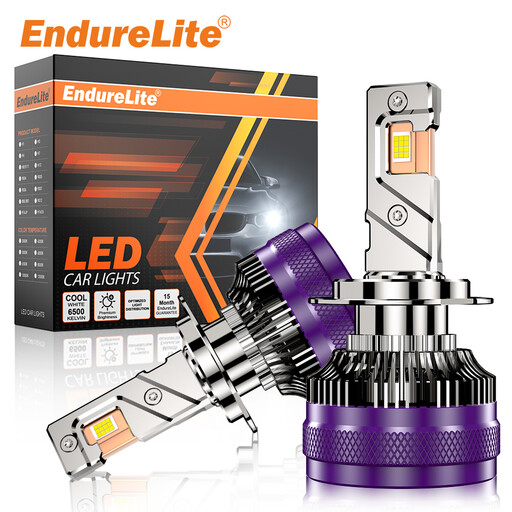
ENdureLite H7 Car Headlight LED Bulbs, 25,000 lm, 6000K, Pack of 2
Why this choice suits this profile: This pack of two bulbs uses a format claimed to be identical to the original bulbs, with plug-and-play installation and a 6000K colour temperature.
The listing mentions a 1:1 design, a built-in driver and claimed CANbus compatibility. Still, check the reference is compatible with your vehicle before buying.
Claimed colour temperature of 6000K, built-in fan, claimed IP68 protection and a stated operating life of 50,000 hours.
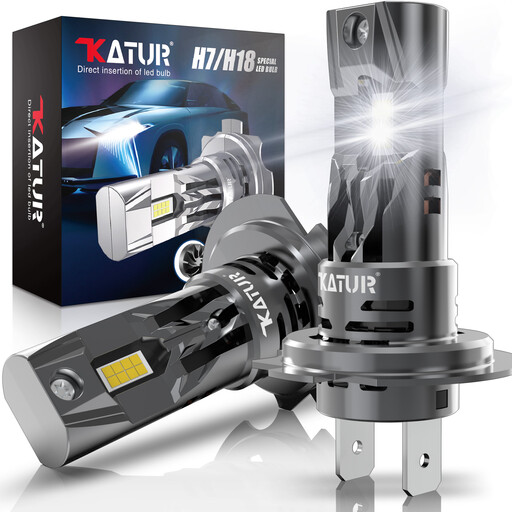
KATUR H7 LED Headlight Bulbs, 100 W, 30,000 Lumens, 6000K, Pack of 2
Why this choice suits this profile: This model is aimed at drivers who want a high claimed light output and a compact format for regular night driving.
Its mini 1:1 format limits the risk of interference with the housing and headlight cover. The listing does note that some vehicles may require decoding adaptation.
Claimed 16,000 rpm fan, 11–18 V power supply, compact design and claimed 98% CANbus compatibility according to the listing.
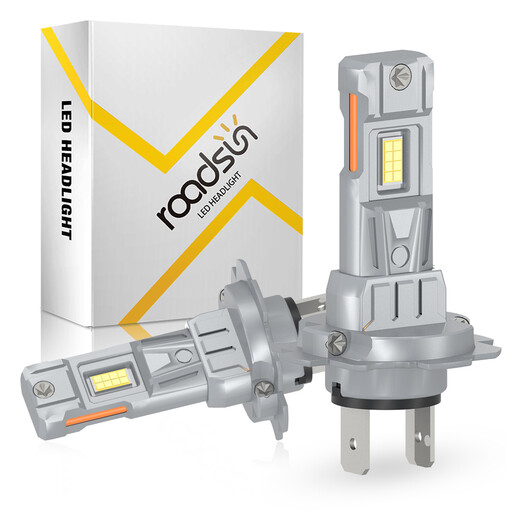
Roadsun LED H7 Headlight Bulbs, 6000K, Mini 1:1 Format, Pack of 2
Why this choice suits this profile: This model is presented for cars, SUVs, vans, motorbikes, quads and other leisure vehicles. Its design targets environments subject to vibration and weather.
The listing claims plug-and-play installation with no extra adaptor needed. Still, check the space around the fan and the regulations that apply to your vehicle.
Mini 1:1 format, aluminium housing, claimed resistance to water, dust and vibration, with a temperature range of –40°C to +80°C.
Looking for other options?
We’ve put together a comprehensive, real-time selection of products that meet these strict criteria and European safety requirements.
Installation and Checks After Replacement
An installation that’s described as tool-free doesn’t let you off the basic checks. Replace the bulbs one at a time, avoid touching the LED chips directly, then lock the base securely. The fan must be able to spin freely, without being obstructed by any part of the headlight.
After fitting, park the vehicle facing a wall on a level surface. Compare the height and sharpness of both beams. If the cut-off line looks uneven or too high, have the headlight alignment checked. On more sensitive vehicles, an error message may appear despite the CANbus claim; a decoder suited to your specific model may then be needed.
FAQ on H7 LED Car Bulbs
Are H7 LED bulbs compatible with all vehicles?
No. An H7 bulb only fits a housing designed for that format. The available space, connector and electronics can vary significantly from one vehicle to another. Check your car’s manual and the compatibility list provided on the product page.
What lifespan can you expect from an H7 LED bulb?
Product listings often claim 50,000 to 60,000 hours. This is a lifespan stated by the manufacturer, usually measured under specific conditions. Heat, vibration, switching cycles and the quality of the electrical circuit can all reduce the actual lifespan you experience.
Do LED bulbs use less power than a halogen bulb?
It depends on the actual electrical power the bulb draws and on your vehicle. The lumen count alone doesn’t tell you whether consumption is lower. Check the wattage, the operating voltage and the compatibility with your vehicle’s electronic monitoring circuit.