
Hands-Free Electric Breast Pumps: How to Choose the Right One
For new mothers, balancing breastfeeding with an active life is often a real juggling act. The hands-free electric breast pump emerges as the promise of reclaimed freedom. But be careful: in a saturated market, it's easy to be tempted by a device that turns out to be uncomfortable, noisy, or inefficient.
As a Product Expert at Joybuy, my mission is to help you decode the spec sheets to make the right choice. Here are the pitfalls to avoid and the essential criteria to check before you buy.
Wearable Breast Pumps: The 3 Pitfalls to Avoid
Marketing often highlights appealing features that can prove disappointing in practice.
- The "Completely Silent" Myth: Many models claim to be discreet, but even a faint motor noise can quickly become distracting at the office or in a public place. To be considered truly quiet, a breast pump should not exceed a certain decibel level.
- The Comfort Compromise: One-Size-Fits-All: A poorly-fitting flange is the number one cause of painful pumping and a drop in milk supply. Models that skip offering different flange sizes forget one essential fact: every body is unique. The result: the device can be simply unusable.
- The Cleaning Headache: A breast pump with numerous small parts that are difficult to assemble and wash quickly becomes a daily burden. Since hygiene is non-negotiable, a tedious cleaning process is the surest way to give up on using it.
A Closer Look at the Technical Criteria for Making the Right Choice
Forget the marketing promises and focus on objective data. Here are the three key points to check.
1. The Actual Noise Level (in Decibels)
For a portable breast pump, silence isn't an option: it's the number one criterion. Instead of a vague claim like "quiet," demand a specific number.
- Under 45?dB: This is equivalent to a whisper or the ambiance of a library. A device at this level guarantees foolproof discretion, even in an open-plan office.
- Between 45 and 55?dB: The noise is noticeable but still discreet, comparable to a modern refrigerator. A good compromise for home use.
- Above 55?dB: The noise is equivalent to a normal conversation. So much for discretion!
2. Battery Life and Charging Simplicity
A cordless breast pump should free you, not chain you to an outlet.
- Battery Life: Rely on the number of pumping sessions (knowing a session lasts 15 to 20 minutes on average) rather than a duration in hours. A battery life of 6 to 8 sessions per charge is an excellent indicator for on-the-go use.
- Connectivity: Prioritise a USB-C port. Now a universal standard, it allows you to charge your device with the same cable as your smartphone or laptop. A real plus for lightening your bag.
3. Pumping Modes and Adjustability
Efficiency and comfort directly depend on the pump's ability to adapt to your body and your rhythm.
- Single or Double Pumping: A double breast pump allows you to express milk from both breasts simultaneously. It's a significant time-saver that can also help maintain a good milk supply. A single model will be more compact and often more affordable.
- Suction Levels and Flange Sizes: A good device should offer multiple suction levels (at least 9) and include different flange (or shield) sizes. A precise fit is key to effectively stimulating the milk let-down reflex without pain. Ensure the materials in contact with the skin are soft silicone and guaranteed BPA-free.
Hands-Free Electric Breast Pump Picks
Here are a few models that check all the boxes, designed for different user profiles.
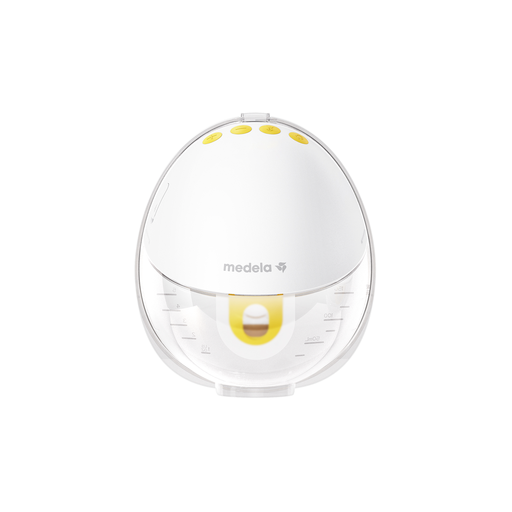
MEDELA Motion InBra - Single Electric Breast Pump
Why it stands out: Designed to slip into a nursing bra, its feather-light weight and quiet motor make it the perfect ally for pumping discreetly at the office or on the go.
It advertises a noise level below 45 dB, a promise of discretion that it keeps. It also comes with 3 silicone inserts to adapt the 24 mm flange, solving the fit problem.
Its feather-light weight (around 250 g) and compact design ensure comfortable wear, while its mere 3 parts, which are dishwasher-safe, radically simplify cleaning.
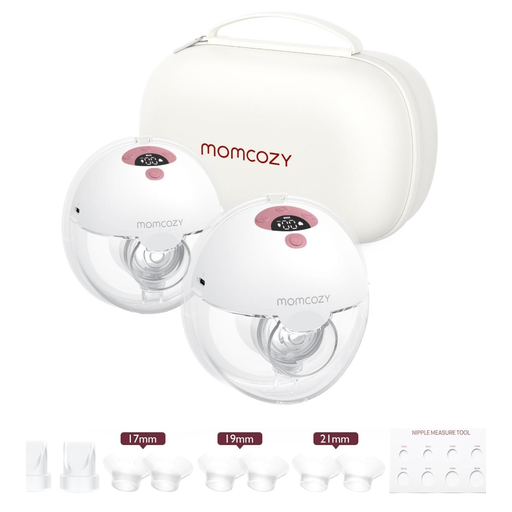
Momcozy M5 Wearable Breast Pump (2-Pack)
Why it stands out: Ideal for mothers who want to optimize every minute. Double pumping and various modes allow you to maximize milk collection while keeping your hands free for other tasks.
It counters the one-size-fits-all trap by including 4 flange sizes (17, 19, 21, and 24 mm) out of the box, ensuring a custom fit for most body types.
Its micro-vibration technology and 3 modes (stimulation, expression, mixed) mimic a baby's natural suckling for faster, more efficient pumping.
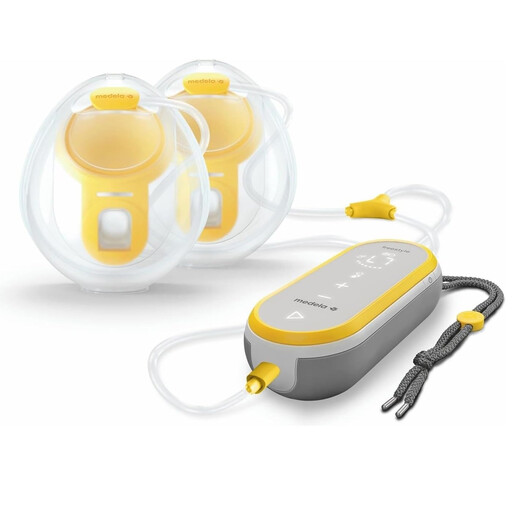
MEDELA Freestyle Hands-Free - Double Electric Breast Pump
Why it stands out: Perfect for the mom who loves to track and optimize everything. The connection to the dedicated app allows you to program and monitor each pumping session for a 100% modern and integrated experience.
No more cleaning headaches: its design consists of just 3 parts, which are ultra-simple to assemble and dishwasher-safe. Bonus: the transparent collection cups let you check for proper nipple alignment at a glance.
The connection to the Medela Family app, which automatically logs sessions and offers personalized tips. Its collection cups are also among the lightest on the market (76 g each).
Need More Options?
We have selected a full range of products for you that meet our quality criteria and current safety standards.
Frequently Asked Questions
What is the lifespan of a hands-free electric breast pump?
It all depends on the parts. The motor unit is designed to last for several years under normal use. However, the silicone parts (flanges, valves, diaphragms) wear out and lose their elasticity. To ensure perfect hygiene and efficiency, it is recommended to replace them every 3 to 6 months, depending on your usage frequency and the manufacturer's recommendations.
Are cordless breast pumps really as powerful as corded models?
Absolutely. Technology has made huge strides. Recent cordless breast pumps offer suction levels that are entirely comparable to plug-in models, often reaching a suction strength of up to -300?mmHg. Efficiency doesn't just rely on raw power, but also on the pumping technology (like 2-Phase Expression technology that mimics a baby's suckling) and, most importantly, a perfect flange fit.
How do you easily clean a portable breast pump?
For quick and easy cleaning, choose models with few parts (ideally 3 or 4). Check that they are dishwasher-safe (top rack). The best daily routine is to rinse the parts with cold water right after pumping, wash them with hot, soapy water, then rinse thoroughly. Regular sterilisation (daily or weekly, depending on your use) is also essential, always following the manufacturer's instructions.