
How to Choose the Right Portable Bluetooth Speaker
The portable Bluetooth speaker market is a real jungle. Between marketing slogans and confusing spec sheets, it's hard to find your way and easy to make a misstep. Our mission: to help you decode the technical jargon and choose a model that will be a lasting, everyday companion.
To start, let's break down two common traps that can ruin your experience:
- The battery life mirage: An advertised battery life of "?20 hours?" is often measured at a very low listening volume (20-30%). In real-world conditions, at 50-70% volume, this duration melts away. An appealing promise can quickly turn into a nightmare of constant recharging.
- Waterproofing confusion: Terms like "?water-resistant?" or "?splashproof?" can be intentionally vague. A device that is merely splash-resistant (IPX4) won't survive a dip in the pool, unlike a truly waterproof model (IPX7). It's a nuance that makes all the difference for outdoor use.
The Essential Criteria for an Informed Choice
To avoid falling into these traps, it's best to stick to a few objective technical specifications. These, not marketing, reveal the true value and durability of your future wireless speaker.
1. The IP Rating: Your Guarantee Against the Elements
The Ingress Protection (IP) rating is an international standard that defines a device's resistance to dust (the first digit) and water (the second digit). For an outdoor Bluetooth speaker, the second digit is what matters most.
- IPX4: Protection against water splashes. Perfect for the kitchen or a surprise rain shower, but don't expect more.
- IPX5: Protection against low-pressure water jets. You can safely rinse it under the tap.
- IPX6: Protection against powerful water jets. Ideal for the beach, it can handle both sand and waves.
- IPX7: Protection against temporary immersion (up to 1 metre for 30 minutes). This is your ticket to total peace of mind by the pool or on a boat. A truly waterproof speaker.
2. Power and Battery Life: An Inseparable Duo
Power, expressed in Watts (W), gives an idea of the maximum sound volume. But be careful, you must distinguish between RMS power (continuous and real) and peak power (maximum for a short burst). The only one that counts: RMS power.
- 5-15W RMS: Ideal for personal listening in a bedroom or office. Perfect for a compact travel speaker.
- 16-40W RMS: The sweet spot for providing sound for a living room, a patio, or a picnic with friends. It's often in this range that you'll find models with powerful bass and balanced sound.
- 50W RMS and up: Essential for powering outdoor parties or filling large spaces.
Naturally, more power means more consumption. Aim for at least 8 to 10 hours of listening time at moderate volume to avoid running out of battery mid-party.
3. Connectivity: Beyond Just Bluetooth
Bluetooth is the standard, but other connection options can be game-changers:
- Auxiliary input (3.5mm jack): Essential for connecting an old MP3 player or a computer, and often a good way to save battery.
- Wi-Fi (for multi-room speakers): The key to creating a synchronised audio ecosystem at home. The connection is more stable and the sound quality is much better than Bluetooth.
- Stereo Pairing (TWS): Allows you to link two identical speakers to create a true stereo soundstage, with separate left and right channels.
- USB-C: Finally the standard! More convenient and faster than the ancient micro-USB, this is the port to demand.
Recommended Bluetooth Speaker Picks
Rather than an endless list, we've selected models tailored for specific uses. It's up to you to find the one that fits your style.
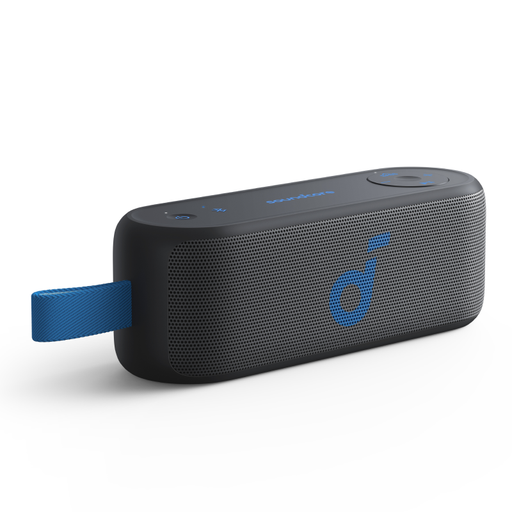
Soundcore Select 3, 16W Stereo Sound
The profile: Ultra-light at 575 g, it slips into any bag. Its extra-long 20-hour battery life makes it the ideal companion for long days at the beach, on a hike, or simply in the garden, far from any power outlet.
Its IPX7 certification isn't just marketing: it guarantees true resistance to immersion, far beyond a simple splash. Its battery life is calibrated for realistic on-the-go use, saving you from running out of power in the middle of the afternoon.
An unbeatable weight-to-battery-life ratio, with total waterproofing for truly hassle-free use.
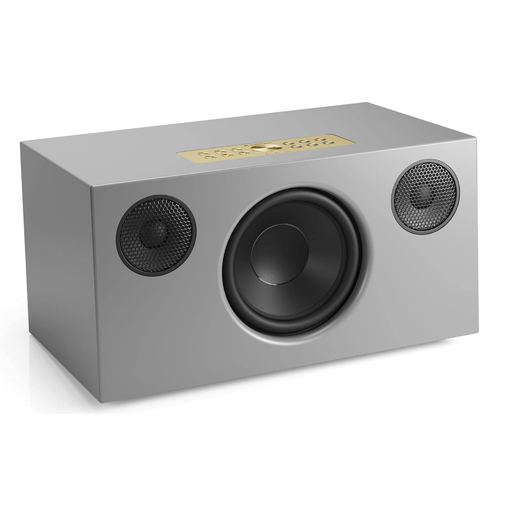
Audio Pro C10 MkII Multiroom Speaker
The profile: Designed for Hi-Fi listening at home, it shines with its ultra-comprehensive connectivity (Wi-Fi, AirPlay 2, Google Cast) and multi-room compatibility. With its clean Scandinavian design and 80 W under the hood, it's as much a beautiful object as it is an excellent speaker.
Here, Bluetooth is just one option. The far more stable Wi-Fi connection opens the door to lossless audio streaming and a seamless multi-room experience, where Bluetooth falls short in range and quality.
Hi-Fi-grade sound quality (80 W amp) and exemplary multi-room integration for building a true audio ecosystem at home.
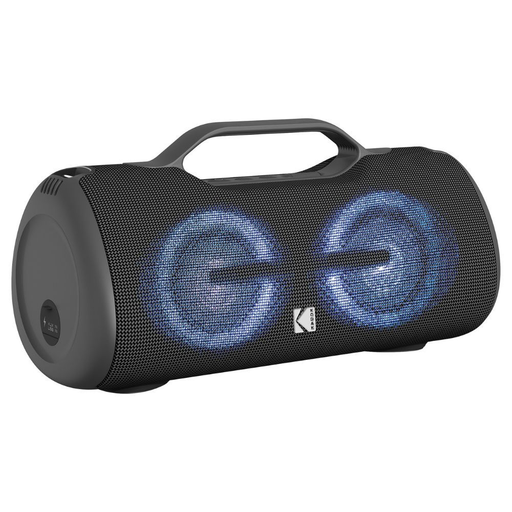
Kodak Portable Wireless Speaker, 60W
The profile: Perfect for livening up outdoor parties with its 60 W of power, DSP-boosted bass, and a power bank function to ensure a smartphone never dies. Its IPX5 certification protects it from rain showers and water splashes.
It refuses to compromise between power and portability. Its 60 W and dedicated bass DSP deliver sound with real punch outdoors, where more compact models give up. The power bank function is the bonus that makes all the difference when you're on the move.
A huge reserve of power for the outdoors and the ultra-practical power bank function for when you're far from an outlet.
Looking for other options?
Discover our full selection of products, all tested and approved according to our quality criteria and industry standards.
Frequently Asked Questions
How many watts should I choose for a Bluetooth speaker?
It all depends on your needs. For personal listening (office, bedroom), 5 to 15?W RMS is more than enough. To provide sound for a living room or a picnic, aim for 20 to 40?W RMS. Above 50?W RMS, you're looking at party speakers designed to fill large spaces with sound.
How can I extend my speaker's battery life?
A few good habits can make all the difference. Avoid repeatedly draining the battery completely. Don't leave the speaker plugged in continuously once it's 100% charged. Finally, store it at room temperature, away from freezing temperatures and extreme heat (like inside a car in direct sunlight).
Can you connect a Bluetooth speaker to a PC?
Absolutely, and in several ways. If your PC has Bluetooth, pairing takes just a few clicks. If not, almost all portable speakers have an auxiliary input (3.5mm jack) for a reliable wired connection. Some models are even specifically designed as PC speakers, with USB connectivity and a format optimised for a desk.