
Portable Projector Buyer’s Guide: Avoid Pitfalls and Choose Wisely
The promise of a 100-inch cinema screen you can set up anywhere, from the bedroom to the garden, is certainly appealing. The portable projector market has exploded in popularity, promising an immersive experience within easy reach. But behind this trend lies often misleading marketing and an army of disappointing products. Before you take the plunge, it's crucial to understand the pitfalls that can turn your home cinema projector dream into a nightmare.
This guide breaks down the features that truly matter and helps you make an informed choice tailored to your actual needs.
The 3 Pitfalls to Avoid When Buying a Portable Projector
Between the technical jargon and overloaded product sheets, it's easy to be fooled. Here are the three most common traps to avoid at all costs.
- The mirage of marketing "lumens": Many entry-level models boast staggering brightness figures (sometimes thousands of "lumens"). The problem? This value is often not standardised and in no way reflects actual performance. The result: a dull, washed-out image as soon as the room isn't in complete darkness, making the projector unusable during the day or with even a simple ambient light.
- False "smart" promises: A projector advertised as "Smart" or running on Android is no guarantee of a smooth experience. Many models come with versions of Android that are not certified by Google. The consequence: flagship apps like Netflix, Disney+, or Prime Video may not work, refuse updates, or stream in low resolution (480p) due to a lack of official DRM certifications. For a seamless HD experience, a Netflix projector must be officially certified.
- Manual keystone correction: a real headache: Most projectors offer keystone correction to straighten the image when the device isn't perfectly aligned with the wall. The catch is that purely manual or only vertical correction is often tedious and tends to degrade sharpness at the edges of the image. Likewise, the absence of an autofocus projector forces you to manually refocus it every time you move it.
The Essential Criteria for an Informed Choice
To ensure you don't make a mistake, focus on the specifications that make a real difference in image quality and user experience.
1. Brightness: Demand the ANSI Lumens Standard
The only reliable and standardised measurement for comparing brightness is the ANSI lumen. This is a non-negotiable criterion. Unlike the fanciful marketing "lumens," this value is measured according to a strict protocol. Here are a few guidelines:
- 200-400 ANSI lumens: Ideal for a very dark room (a bedroom at night) and modest screen sizes (up to 80 inches).
- 500-800 ANSI lumens: The sweet spot for a living room with low ambient light. This is the threshold for versatility in a home cinema projector.
- Over 800 ANSI lumens: Allows for comfortable viewing even with moderate ambient light, perfect for outdoor evenings or living rooms.
2. Resolution: Don't Confuse "Native" with "Supported"
This is a classic marketing trap. A projector can be "4K compatible" (or "supports 4K"), which simply means it can accept a 4K input signal. But the image will then be downscaled to be displayed at its actual, or native, resolution.
- 720p Native Resolution (1280x720): Acceptable for on-the-go use or on small diagonals, but pixels will be noticeable.
- 1080p Native Resolution (1920x1080): This is the current standard for a sharp, detailed image. It's essential for enjoying films and video games on a large screen and the minimum you should demand for a good experience.
- 4K Native Resolution (3840x2160): The holy grail for exceptional image sharpness, but still reserved for more expensive models.
3. Smarts and Connectivity: The Key to a Hassle-Free Experience
A good portable projector should be straightforward and versatile.
- Wi-Fi and Bluetooth:Wi-Fi 6 is a real bonus for smooth video streaming from your favourite platforms. Bluetooth (5.0 or higher) is essential for connecting a soundbar, headphones, or a wireless speaker.
- Operating System (OS): Opt for certified systems like Google TV or Android TV, or proprietary OSes that guarantee licenses for major apps (Netflix, etc.). This ensures you'll receive updates and maintain long-term compatibility.
- Automation: The combination of an autofocus projector and automatic (multi-point) keystone correction is a complete game-changer. The projector calibrates itself in seconds every time you move it, ensuring a consistently sharp and perfectly rectangular image.
Our Portable Projector Recommendations
Rather than an endless list, here are three models that cater to specific user profiles, all meeting the quality criteria we've just covered.
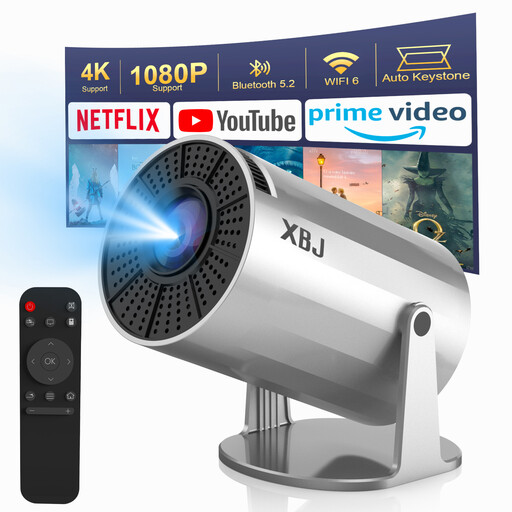
XBJ Portable Silver Projector with Wi-Fi 6 & Bluetooth 5.2
Who is it for? Ideal as an ultra-portable solution to slip into a bag for impromptu screenings in a bedroom or on holiday. Its 180° rotating stand is perfect for projecting onto the ceiling to watch a film cozied up under the covers.
It integrates Android 11, Wi-Fi 6, and Bluetooth, which prevents it from being just a "dumb" projector. Although a streaming stick (like a Chromecast) is sometimes recommended for perfect app compatibility, it offers a solid connected foundation.
Projection Flexibility: Its 180° rotating stand is a real bonus for finding the perfect angle in a flash. Simplicity: The automatic vertical keystone correction makes setup much easier.
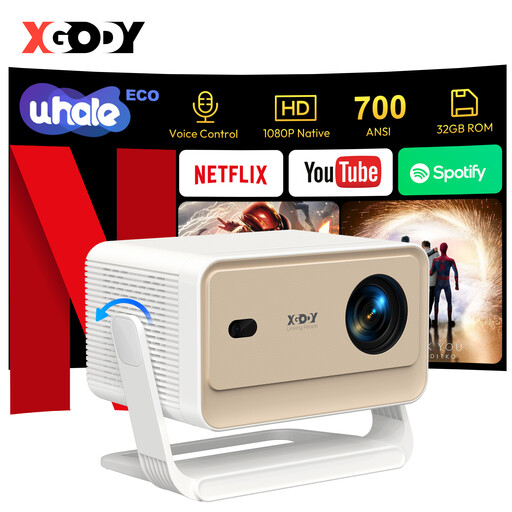
XGODY N6 Pro Portable Projector, 4K Supported, Native1080P&700ANSI
Who is it for? Perfect for families who want a plug-and-play solution for the living room. Its high brightness and 100% automatic adjustments allow anyone to start a movie night in seconds, without any technical knowledge.
It avoids the "false smart promises" trap thanks to its official Netflix license and WhaleOS 3.0 system. Its 700 ANSI lumens are a reliable figure that protects it from the mirage of marketing numbers.
Absolute Simplicity: The autofocus, keystone correction, obstacle avoidance, and screen alignment are all fully automatic. You set it down, and it handles everything. Image Quality: The native 1080p resolution and 700 ANSI lumens ensure a clear image even without being in complete darkness.
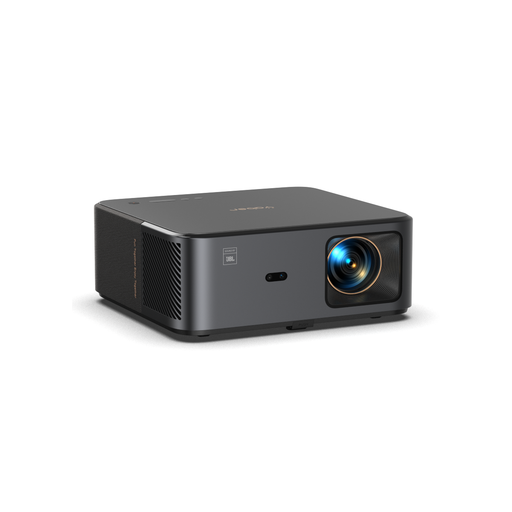
YABER K2s Projector 4K With Google TV, Wi-Fi 6 & Bluetooth
Who is it for? Designed for cinephiles and tech enthusiasts who don't want to compromise. It combines a very bright image, quality sound by JBL, and a complete smart ecosystem with Google TV for a premium experience.
With its 800 ANSI lumens, the pitfall of a dim image is gone. The integration of certified Google TV guarantees native, functional access to Netflix and over 7,000 other apps, eliminating the problem of "pseudo-smart" systems.
Superior Sound Quality: The two 10W JBL speakers with Dolby Audio support deliver powerful, clear sound that can make an external soundbar unnecessary. Complete Ecosystem: Google TV, Wi-Fi 6, NFC Screencast, and Alexa voice control make it a true entertainment hub.
Want to Explore Other Models?
Discover our full selection of projectors that meet our quality criteria and European safety standards.
Frequently Asked Questions (FAQ)
What is the lifespan of an LED portable projector's lamp?
Almost all modern portable projectors use an LED light source, one of whose main advantages is longevity. Manufacturers typically state a lifespan of between 20,000 and 50,000 hours. To give you an idea, that's over 13 years of use at 4 hours per day. This is far longer than older mercury lamps.
Do I need a projection screen, or is a white wall enough?
For occasional use, a smooth, matte white wall can certainly do the trick. However, to achieve the best contrast, accurate colours, and optimal brightness, a real projection screen remains unmatched. Its material is specially designed to reflect light much more uniformly and efficiently than a simple painted wall.
Can a portable projector replace a TV?
It all depends on your use case. For movie nights, major sporting events, or gaming sessions, the immersion offered by a projector is incomparable. On the other hand, for watching the news in the middle of the day in a brightly lit living room, a television will always have the edge in terms of brightness and contrast. The mini projector is therefore an excellent companion to a TV, not necessarily a replacement.