
Portable Solar Panels: How to Choose the Right One
Running out of battery on your smartphone or laptop in the middle of nowhere: it's the worst fear of every adventurer and digital nomad. A portable solar panel seems like the perfect solution, but the market is flooded with marketing promises that too often end in disappointment. Before you invest, it's crucial to know how to avoid the pitfalls to achieve true energy independence.
This guide breaks down the essential criteria and helps you identify the product that will genuinely meet your needs, cutting through the marketing noise.
The 3 Pitfalls to Avoid When Buying a Solar Charger
Buying a portable solar kit can quickly become a headache. Here are three common pitfalls that could make your investment worthless.
- Advertised Power vs. Real-World Output: Many manufacturers display power ratings (in watts) measured under ideal lab conditions that are rarely replicated in the field. The result? A 100W panel will often struggle to deliver more than 60-70W, even in bright sunshine, due to heat, the angle of exposure, or cell technology.
- Limited Compatibility: The nightmare scenario: you buy a powerful panel, but its single connector is incompatible with your portable power station or devices. Scrambling for hard-to-find adapters is a classic issue that defeats the entire purpose of portability.
- Impractical Design: A panel that is heavy, bulky when folded, or lacks kickstands quickly becomes a burden rather than an asset. Ease of transport and deployment is just as crucial as electrical performance, especially for a camping or hiking solar charger.
Technical Criteria to Check Before You Buy
To make an informed choice, you must focus on the technical specifications that determine the performance and versatility of your future panel.
1. Efficiency and Cell Type
Efficiency (or conversion efficiency) refers to the percentage of solar energy the panel converts into electricity. The higher this rate, the more power the panel will provide for a given surface area.
- Monocrystalline Cells: These generally offer higher efficiency (often exceeding 22%) and better performance in low-light conditions than polycrystalline cells. They are the standard to look for today for portable use, where every square inch counts. A high-efficiency 200W panel will therefore be more compact and lighter than a model with the same power but lower efficiency.
2. Connectivity and Charging Versatility
A good solar panel for a portable power station must be a Swiss Army knife of connectivity. Check for the presence of several types of outputs:
- DC Output (often XT60): This is the go-to port for recharging portable power stations. The inclusion of a cable with multiple adapters (like Anderson, DC5521, DC7909) is a major plus that ensures near-universal compatibility.
- USB Ports: A USB-C solar charger port with Power Delivery (PD) of at least 45W allows you to directly and quickly charge a laptop or tablet. A USB-A port compatible with Quick Charge (QC 3.0) is an ideal addition for smartphones and other small devices.
3. Portability and Ergonomics
A folding solar panel must be practical in reality, not just on the spec sheet.
- Weight and Folded Dimensions: Compare the total weight and the bulkiness of the panel once folded. A good 100W model should weigh between 3 and 4 kg, while a 200W model will be closer to 5-6 kg.
- Adjustable Kickstands: Integrated and adjustable kickstands are essential for easily angling the panel towards the sun to maximise its output throughout the day.
- Carry Handle: A simple detail that makes all the difference when on the move.
Recommended Portable Power Solutions
Rather than a generic product list, we've matched specific solutions to user profiles to help you envision the right solution for you.
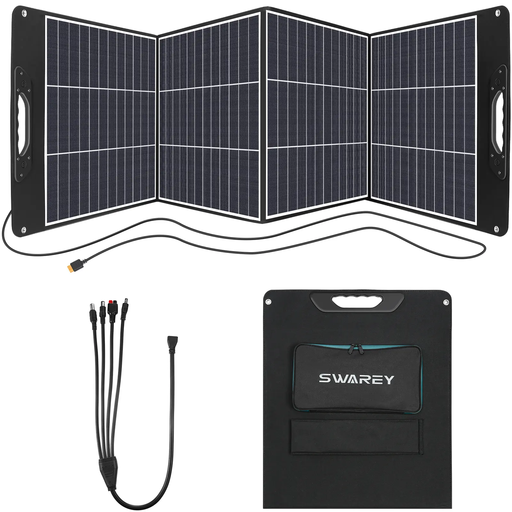
SWAREY 200W Foldable Solar Panel
Ideal for: Van lifers, long-term campers, or anyone needing to power multiple power-hungry devices (power station, cooler, laptop). Its 200W output ensures rapid recharging and near-total energy independence.
It avoids the compatibility trap with its XT60 to 4-in-1 (Anderson/DC) cable, making it compatible with the vast majority of portable power stations on the market. Its output is optimised by 23% efficiency monocrystalline cells.
High Power (200W) for rapid charging. Comprehensive connectivity including USB-C and QC 3.0 for direct device charging. Adjustable kickstands for the perfect angle.
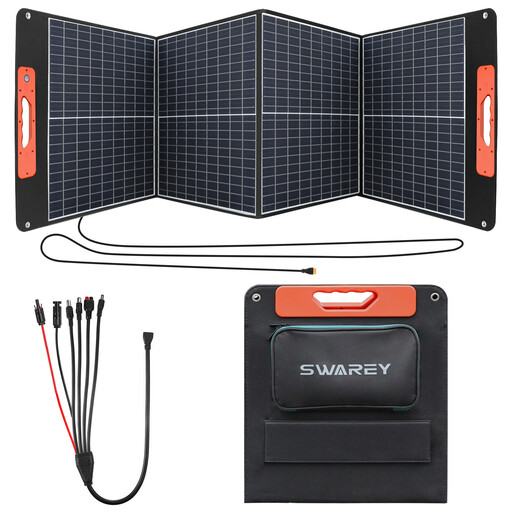
SWAREY 100W Foldable Solar Panel
Ideal for: Perfect for weekend camping trips, hiking, or remote work in nature. Its manageable weight (3.48 kg) and compact 4-panel design make it an excellent balance of power and portability.
It avoids the ergonomics pitfall with its lightweight design, compact folded size, and clever "Ray Tracer" solar alignment aid that helps you find the perfect angle in seconds, thus maximising the actual power captured.
60W USB-C PD Port for charging a laptop directly. Excellent power-to-weight ratio. Integrated alignment aid for maximum efficiency.
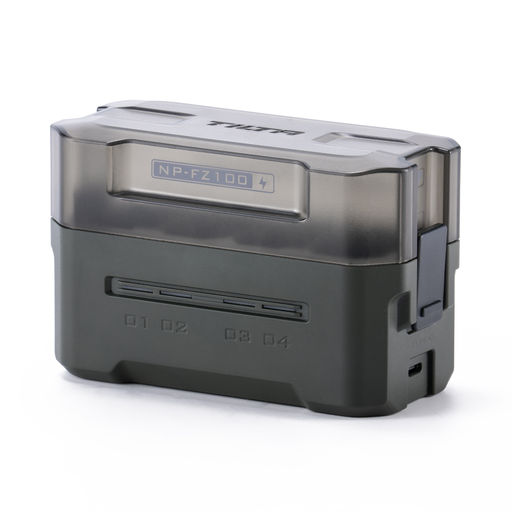
Tilta Portable Charging Station for SONY NP-FZ100 Batteries
Ideal for: For content creators, power is the lifeblood of their work. This charger isn't a panel, but an essential link in the mobile ecosystem. It allows you to simultaneously charge four camera batteries (Sony NP-FZ100) from a power bank, which is itself powered by a solar panel.
It solves a very specific compatibility problem: how to efficiently charge multiple proprietary batteries in the field. Instead of juggling a multitude of individual chargers, it centralises charging and optimises the use of collected solar energy.
Simultaneous charging for 4 batteries, a huge time-saver. Compact and rugged design, made for camera/video bags. Streamlines on-location workflow.
Need a Complete Solution?
For total autonomy, a solar panel is the ideal partner for a high-capacity portable power station. Discover our selection of products that meet these same demanding criteria.
Frequently Asked Questions (FAQ)
1. What is the lifespan of a portable solar panel? Most quality portable solar panels are built to last. The photovoltaic cells themselves have a theoretical lifespan of over 20 years. The product's longevity will primarily depend on the durability of its coating (usually ETFE or PET), hinges, and connectors. With minimal care, a good panel can accompany you on your adventures for 5 to 10 years, or even longer.
2. Can a 100W solar panel charge a laptop? Yes, provided it has the right connectivity. To charge a laptop directly, the panel must have a USB-C Power Delivery (PD) port with sufficient wattage (typically 45W or more), as is the case with the SWAREY 100W model featured. If the panel only has a DC output, you'll need to go through a portable power station, which will act as an intermediary to power the computer.
3. How can I optimise the output of my folding solar panel? To get the best performance, three golden rules apply. First, orient the panel due south (in the northern hemisphere) and tilt it so it is perpendicular to the sun's rays. Adjustable kickstands are essential here. Second, ensure that no shadows (from a tree branch, backpack, etc.) cover even a small part of the cells. Finally, regularly clean the surface with a soft cloth to remove dust or pollen that can reduce efficiency.