
How to Choose a Power Bank and Never Run Out of Battery Again
The flashing red battery icon on your smartphone: a sight we all know too well. Whether you're commuting, travelling, or just at the end of a long day, running out of juice never happens at a good time. Fortunately, the power bank, or portable charger, is the simplest solution to guarantee power for all your devices.
With an overwhelming number of options on the market, it's hard to know where to start. Our mission? To help you cut through the noise with clear information and practical advice, free of unnecessary marketing jargon. This guide is designed to walk you step-by-step towards the model that truly fits your needs.
The Essential Criteria for Choosing the Right Power Bank
Before diving into our selection, it's helpful to understand the three main features that set one portable charger apart from another.
1. Capacity (mAh): Finding the Right Balance Between Power and Portability
Capacity, measured in milliampere-hours (mAh), simply determines how many recharges your power bank can provide.
- Up to 5,000 mAh: Ideal for an emergency top-up. These models are ultra-compact and lightweight, perfect for slipping into a pocket to save you at the end of the day.
- Around 10,000 mAh: This is the sweet spot and the most popular size. A 10,000mAh power bank can recharge a modern smartphone two to three times. It's the perfect balance of capacity and bulk for daily use or a weekend trip.
- 20,000 mAh and above: For long journeys, power users, or for charging more demanding devices like a tablet or laptop. The trade-off is that they are inevitably heavier and larger.
2. Charging Speed (W) and Connectivity (USB-C)
The output power, in watts (W), determines how fast your devices will charge. A fast-charging power bank worthy of the name now relies on technologies like Power Delivery (PD), typically through a USB-C port.
A model with 20W or more is recommended for quickly charging recent smartphones (including a power bank for iPhone). For a laptop power bank, you should aim for 65W or more. Remember to check the maximum power your devices can accept to take full advantage of it.
3. Ergonomics and the Small Details That Make a Big Difference
In daily use, it's the details that count:
- Number and type of ports: Multiple ports (USB-A and USB-C) are a huge plus for charging several devices at once.
- Integrated cables: Some models come with a built-in cable. This is convenient for avoiding the hassle of carrying an extra wire.
- Weight and dimensions: When you're on the move, every gram counts. Be sure to compare the weight and size relative to the capacity.
Top Power Bank Recommendations
We've selected three standout models, each catering to a specific need.
Anker Nano 10,000mAh with Built-in USB-C Cable
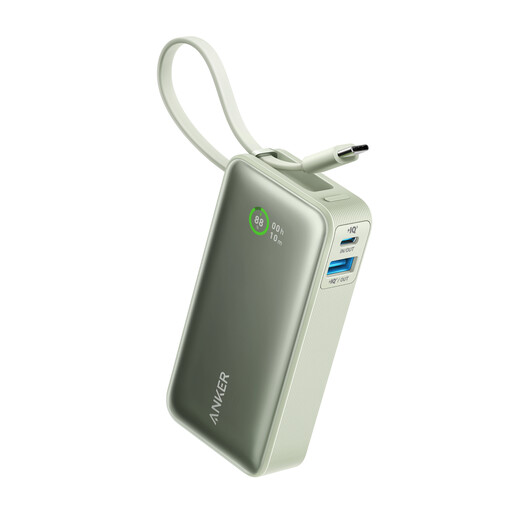
Why it stands out: This model combines a versatile 10,000 mAh capacity with the convenience of a built-in USB-C cable, all in a very compact form factor.
The highlights:
- Built-in USB-C cable: No more hunting for your cables! It's used for both charging your devices and recharging the power bank itself.
- 30W two-way fast charging: According to Anker, its 30W output can restore 50% of an iPhone 14's battery in 30 minutes, and the power bank itself recharges to 50% in 45 minutes.
- Smart design: It's compact and features a small colour screen to accurately monitor the charging status.
- An eco-friendly touch: Its casing is made from 80% post-consumer recycled (PCR) plastic.
Who is it for? The on-the-go user looking for an all-in-one, high-performance solution that's easy to slip into a bag to power their smartphone, headphones, or tablet.
Anker Nano Power Bank 5,000mAh with Foldable USB-C Connector
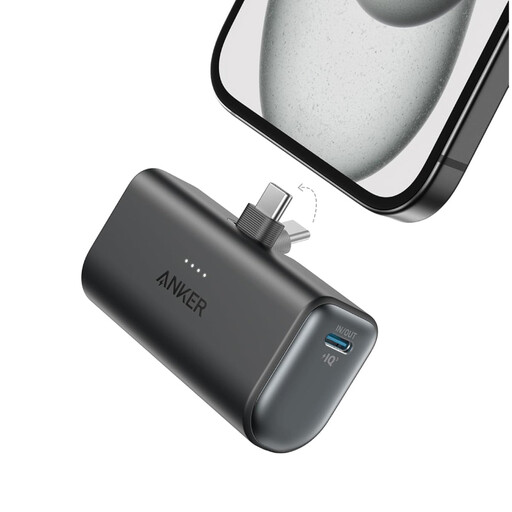
Why it stands out: Its pocket-sized form factor and a foldable USB-C connector that plugs directly into a device, completely cable-free.
The highlights:
- Foldable USB-C connector: No more tangled cables! The connector folds away for easy transport and better protection.
- Feather-light: Weighing only 100g, you'll forget it's even in your pocket or small bag.
- 22.5W power: Despite its tiny size, it delivers ample power for fast-charging most smartphones.
Who is it for? Those who prioritise absolute portability for an emergency charge. It's the perfect companion for a night out, or just to make sure you end the day with battery to spare.
CUKTECH No. 20 Power Bank 25,000mAh, 140W
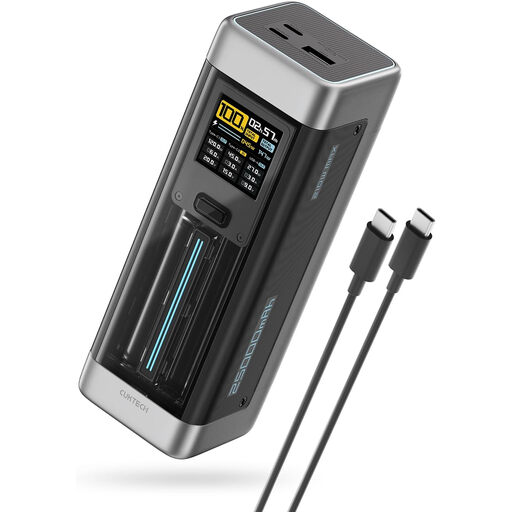
Why it stands out: Its colossal 140W power output and massive 25,000 mAh capacity, built for the most power-hungry devices, especially laptops.
The highlights:
- 140W Power (PD 3.1): Capable of charging a 16-inch MacBook Pro at full speed, it's a true portable power station and an excellent laptop power bank.
- Very high capacity: Its 25,000 mAh can, according to CUKTECH, recharge a MacBook Air about 1.2 times or an iPhone 16 Pro Max 3.3 times.
- Smart TFT screen: The display is a real bonus, showing the real-time battery level, power output, voltage, and current.
- Enhanced durability: It uses automotive-grade battery cells designed to withstand over 1,000 charge cycles.
Who is it for? The professional on the move, the content creator, or the frequent traveller who needs a single, ultra-powerful solution for their entire digital arsenal (laptop, tablet, smartphone).
Didn't Find What You're Looking For?
If these models didn't convince you, don't worry! The market is full of alternatives. From ultra-slim batteries to solar-powered models, there's something for every taste and need.
? Discover our full selection of portable chargers on Joybuy
Frequently Asked Questions About Power Banks
What mAh capacity should I choose for my needs?
To put it simply:
- Emergency top-up (1 charge): 5,000 mAh is enough.
- Daily use (2-3 charges): 10,000 mAh is the ideal compromise.
- Travel or laptops: Aim for 20,000 mAh or more.
Can you take a power bank on a plane?
Yes, but only in your carry-on luggage. Lithium batteries are strictly forbidden in checked baggage. Most airlines limit the capacity to 100 watt-hours (Wh) per battery. The calculation is simple: (mAh / 1000) x V = Wh. For example, a 25,000 mAh battery with a voltage of 3.7V is equivalent to 92.5 Wh, which is therefore allowed. When in doubt, always check your airline's rules before you fly.
How do I know if a power bank is compatible with my device (iPhone, Samsung, etc.)?
It's very simple, you just need to check two things: the connector and the power.
- The connector: Most recent devices (including the latest iPhones) have switched to USB-C. A USB-C power bank is therefore a versatile, future-proof choice. For older devices, check that it also has a USB-A port.
- The power: Take a look at the maximum charging power your device supports. And rest assured, using a more powerful power bank poses no risk: your device will only draw the power it needs.