
Professional Automotive Diagnostic Scan Tools for Your Workshop
Whether you run a garage, are an independent mechanic, or a high-level automotive enthusiast, efficient diagnostics are the lifeblood of your operation. It's the key to your profitability and customer satisfaction. Faced with increasingly complex vehicles packed with electronics and featuring protocols like CAN FD or DoIP, a simple fault code reader is now obsolete. Choosing the right professional automotive diagnostic scan tool is no longer an option—it's a strategic investment.
This article will guide you through the key features to demand in 2026 and present our selection of tools designed for the challenges of today's and tomorrow's workshops.
Recommended Diagnostic Tools
Before diving into our selection, let's review the technical criteria that will truly make a difference in your daily workshop routine.
1. Compatibility with Modern Protocols (CAN FD & DoIP)
To manage the flood of electronic data in modern vehicles, manufacturers are constantly integrating new communication protocols.
- CAN FD (Flexible Data-Rate): It offers a much higher data rate than classic CAN, making it essential for diagnosing recent vehicles (especially from GM, Ford, or Jaguar Land Rover post-2019).
- DoIP (Diagnostics over Internet Protocol): It relies on an Ethernet connection for much faster diagnostics and programming. This is a must-have for brands like BMW (F/G chassis), Volvo, or JLR since 2017. Opting for a CAN FD and DoIP compatible auto diagnostic tool ensures you won't be left unable to service the new models that roll into your workshop.
2. Advanced Functions: Beyond Reading Fault Codes
What distinguishes a professional scan tool from a simple reader is its ability to communicate deeply with the vehicle.
- Bi-Directional Control: Also known as an "active test," this allows you to send commands directly to ECUs to control and test components (actuators, valves, motors, etc.) without having to dismantle them. A huge time-saver for pinpointing the source of a failure.
- ECU Coding: A worthy ECU diagnostic tool must master coding. This ranges from pairing new ECUs after a replacement to customising options (e.g., deactivating the Start/Stop system), and includes the crucial injector coding after a replacement.
3. The Pricing Model: The Importance of Updates
The software is just as critical as the hardware itself. The vehicle fleet is evolving at a dizzying pace. Without regular updates, your tool will quickly lose its relevance and value. Carefully weigh the pricing models: some brands offer a diagnostic tool with free lifetime updates, a major selling point. Others operate on an annual subscription, often after one or more included years. Be sure to calculate the total cost of ownership for your workshop over the long term.
Our Diagnostic Scan Tool Picks
Here are three tools that, through their different approaches, meet the varied needs of professionals, each with its own strengths.
MUCAR 892BT Professional OBD2 Diagnostic Scanner
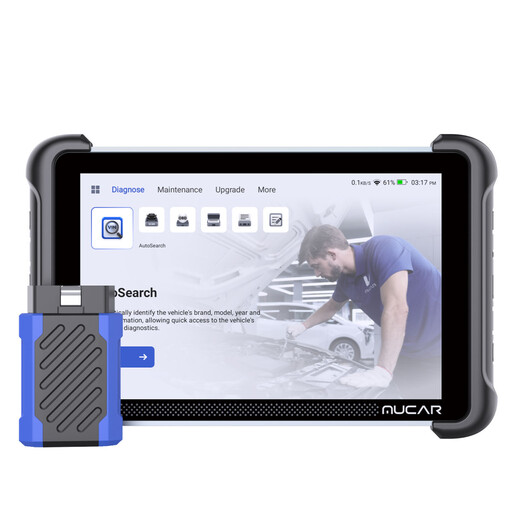
Key Feature: An unbeatable pricing model with free lifetime updates, making it a particularly cost-effective investment over time.
Pros:
- Free Lifetime Updates: No annual subscription to worry about, a decisive financial advantage.
- Extensive Compatibility: Supports CAN-FD and DoIP protocols, ensuring compatibility with the latest vehicles.
- Professional Functions: Includes bi-directional control, advanced ECU coding, and over 34 maintenance services (oil reset, ABS bleeding, injector coding, etc.).
- High-Performance Hardware: A responsive 8-inch touchscreen tablet and a magnetic VCI (dongle), very practical for attaching it to the vehicle during work.
Who is it for? Ideal for garages and independent mechanics who want a complete and powerful workshop auto scanner without the constraint of a subscription.
XTOOL D7W OBD2 Scanner Diagnostic Tool
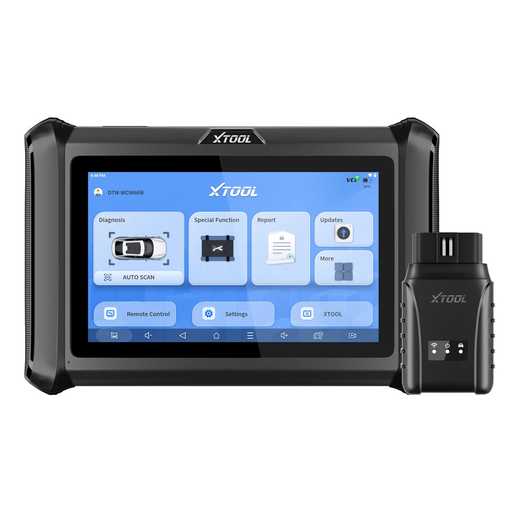
Key Feature: Its wireless connection offers complete freedom of movement in the workshop. Its specialised functions, particularly for key programming, are a real asset.
Pros:
- Wireless Connection: Wi-Fi diagnostics allow you to work freely around the vehicle (up to 20m) without getting tangled in cables.
- Updates Included: Includes 3 years of free updates, future-proofing your investment and ensuring a good return over a long period.
- Comprehensive Service Functions: Over 39 service functions, including key programming, PMI (Programmable Module Installation) for Ford/Lincoln/Mazda, and ECU coding for many brands.
- Modern Protocols: CAN FD/DoIP compatible and features secure gateway access for recent FCA group vehicles (Fiat, Chrysler, etc.).
Who is it for? For workshops that prioritise the flexibility of wireless and have specific needs for key programming or module cloning (PMI).
LAUNCH X431 PRO ELITE 8 inch Car Diagnostic Tool
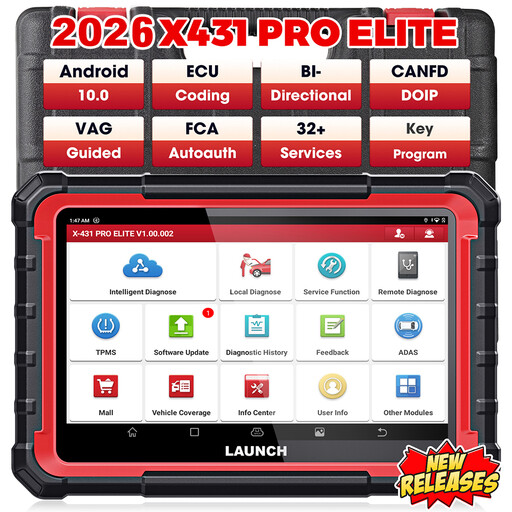
Key Feature: OE-level diagnostics and a modular ecosystem make it an ultra-scalable solution for the toughest faults.
Pros:
- OE-Level Diagnostics: Access to all vehicle ECUs, with a diagnostic depth equivalent to the manufacturer's own tool.
- Expandable Ecosystem: Compatible with numerous optional modules: oscilloscope, battery tester (BST360), endoscope, key and immobiliser programmer (X-PROG 3), etc.
- Powerful Functions: Full bi-directional control, ECU coding, guided functions for the VAG group (VW, Audi, etc.), and over 31 maintenance services.
- Very Wide Coverage: Massive vehicle coverage (over 200,000 models) and support for CAN FD/DoIP protocols.
Who is it for? Expert workshops and technicians who demand a comprehensive, precise, and scalable diagnostic solution capable of tackling the most complex cases.
Looking for Other Options?
The auto diagnostic market is vast, and every workshop has its own constraints. If these three models don't check all your boxes, whether in terms of budget or features, many other solutions exist.
Feel free to explore our complete category to discover a wider selection of automotive diagnostic scanners and find the tool that will become your workshop's best ally.
Frequently Asked Questions
What's the difference between a basic OBD2 scanner and a professional diagnostic tool?
To put it simply, a basic OBD2 scanner only reads and clears fault codes (DTCs) related to the engine and emissions system. In contrast, a professional automotive diagnostic scan tool (or an advanced multi-brand OBD2 scanner) communicates with all of the vehicle's ECUs: ABS, airbags, transmission, climate control, etc. Most importantly, it offers active functions like bi-directional control (to command components), ECU coding, and dozens of service procedures (steering angle calibration, DPF regeneration, etc.).
Are updates really necessary for a workshop's auto scanner?
Yes, and it's non-negotiable. Each year brings new models, new ECU versions, and software updates. Without an up-to-date tool, you simply won't be able to communicate with recent vehicles that enter your workshop, making diagnosis impossible or, worse, inaccurate. It is the number one criterion for ensuring the longevity of your investment.
Can a diagnostic tool perform injector coding?
Absolutely. Most professional diagnostic scan tools include the injector coding function. When an injector is replaced, it is imperative to write its calibration code (often called a C2i or IMA code) into the engine control unit (ECU). This step allows the ECU to finely adjust the amount of fuel injected for that specific cylinder. This guarantees optimal engine performance, controlled fuel consumption, and compliance with emissions standards. It is a standard procedure for a professional-grade tool.