
Rugged Smartphone Buying Guide for Work and Adventure
By the Joybuy Team, your high-tech experts
A cracked screen from a small drop, a phone soaked by a sudden downpour, a battery that dies on you mid-job... These everyday frustrations are more than just annoying: they can bring your business to a halt or ruin an outdoor adventure. If you're tired of overly fragile smartphones, your search is over.
This guide breaks down the world of rugged smartphones. Forget the marketing jargon: we're getting straight to the point by analysing the technical specs that really matter. Our goal? To help you choose a reliable companion, one that can keep up with you on the most demanding job sites and during your wildest adventures.
How to Choose a Rugged Phone for Your Needs?
The rugged phone market is booming, but not all models are created equal. To ensure you make the right choice, here are the three key criteria to look at closely.
1. Durability Ratings: IP and MIL-STD, Your Seals of Trust
These complex acronyms are the best indicator of your future smartphone's durability. They aren't just marketing buzzwords, but serious standards backed by rigorous testing.
- Ingress Protection (IP) Rating: This evaluates resistance to dust (the first digit) and water (the second digit). For a truly shockproof and waterproof smartphone, aim for a minimum of an IP68 rating. This guarantees protection against prolonged submersion (usually up to 1.5 metres for 30 minutes). The even more stringent IP69K standard ensures resistance to high-pressure, high-temperature water jets, making it a must-have for industrial or agricultural settings.
- The Military Standard (MIL-STD-810H): This U.S. military certification subjects the phone to a battery of extreme tests: shocks, vibrations, drops (typically from 1.5m onto concrete), and extreme hot and cold temperatures. A device that passes these trials is a true worksite phone, built to withstand anything.
2. Battery Life: The Game-Changer for Outdoor Use
What good is an indestructible phone if the battery is dead? For long days in the field or multi-day treks, massive battery life isn't an option—it's a requirement.
The number to look for is the battery capacity, measured in milliampere-hours (mAh). A good large-battery smartphone starts at around 8,000 mAh, but the top contenders in this category surpass 20,000 mAh—enough to last for days without a charge. Also, look for fast charging and, most importantly, reverse charging (OTG). This handy feature transforms your phone into a power bank to rescue another device.
3. Performance and Special Features: More Than Just a Tough Shell
A rugged mobile phone no longer means compromising on performance. Recent models are packed with powerful components. Ensure the processor/RAM combination is up to the task of running your professional applications to avoid any slowdowns. 5G compatibility is also a huge advantage in a rugged 5G smartphone, ensuring you have an ultra-fast connection wherever you are.
Some models stand out with unique features worthy of a secret agent: a thermal camera, an integrated projector, or even programmable buttons for one-touch access to functions like push-to-talk or the camera.
Recommended Rugged Smartphones
To help you decide, we've selected three models that meet different needs, all while sharing a common foundation of ruggedness and reliability.
1. DOOGEE Blade 20: The Endurance Champion
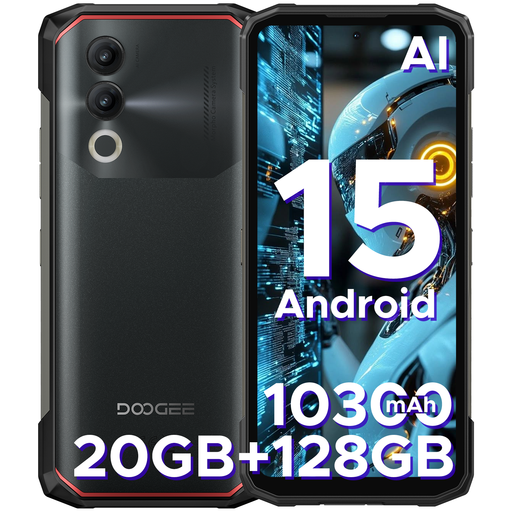
Why it stands out: The DOOGEE Blade 20 is all about exceptional endurance. Its colossal battery is designed for those who spend their days far from an outlet. Better yet, it doesn't just last—it shares its power via OTG reverse charging, making it a formidable ally in the field.
Key features:
- Giant 10,300 mAh battery with 18W fast charging and OTG reverse charging.
- 20 GB of RAM (4 GB + 16 GB virtual) for perfectly smooth multitasking.
- 6.6-inch HD+ display with a 90 Hz refresh rate for smoother navigation.
- Robust aluminium-titanium alloy chassis.
- Runs on Android 15 for a modern and secure software experience.
Who is it for? For construction pros, farmers, and field technicians who require a work tool where battery life is the top priority.
2. Unihertz Tank 3 Pro: The Tech Swiss Army Knife
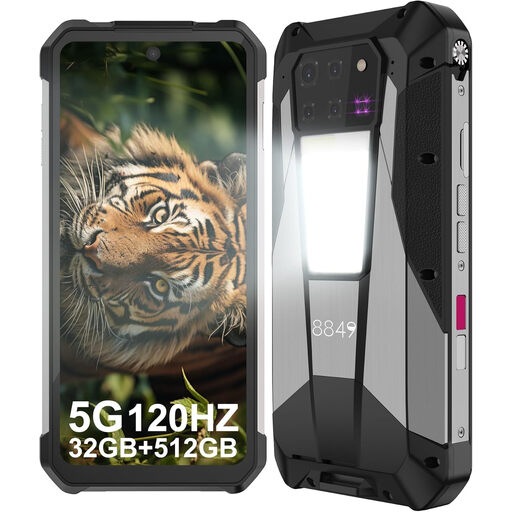
Why it stands out: The Unihertz Tank 3 Pro is a true game-changer that redefines the category. With its gargantuan battery, first-class performance, and—the icing on the cake—a built-in DLP projector, it's far more than just a phone. It's a mobile workstation and entertainment hub, ready for any challenge.
Key features:
- Record-breaking 23,800 mAh battery for multi-day battery life.
- Built-in 100-lumen DLP projector for on-the-fly presentations.
- High-end performance with the Dimensity 8200 processor and 5G connectivity.
- 32 GB of RAM (16 GB + 16 GB virtual) and 512 GB of storage.
- Versatile camera system with a 200MP main sensor and a 64MP night vision camera.
Who is it for? For tech enthusiasts, project managers who need to show plans on-site, and adventurers who want a do-it-all device that can even project a movie under the stars.
3. Blackview Fort 2: All the Toughness, Less of the Bulk
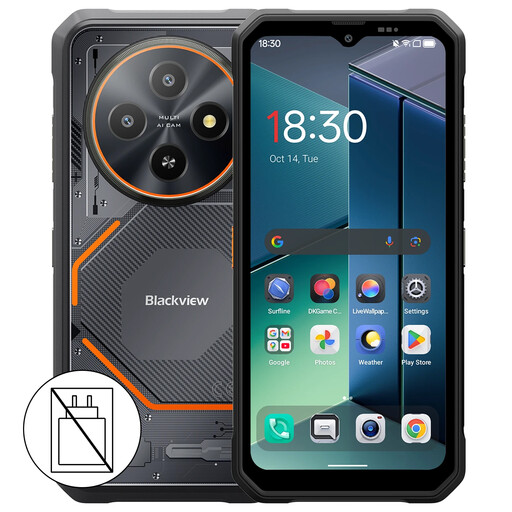
Why it stands out: The Blackview Fort 2 proves that a rugged smartphone doesn't have to be a brick. With its slim profile and lightweight design, it integrates top-tier protection (IP68/IP69K and MIL-STD-810H) into a form factor that is far more comfortable for daily use.
Key features:
- Ultra-slim (10.7 mm) and lightweight (245 g) design for a rugged phone.
- Full IP68/IP69K and MIL-STD-810H certifications.
- 24 GB of RAM (8 GB + 16 GB virtual) and 256 GB of storage, expandable up to 2 TB.
- 6.56-inch HD+ display with eye protection modes.
- Integrated AI assistants to boost your productivity.
Who is it for? For hikers, athletes, and anyone prone to accidents who wants a durable daily driver without sacrificing style or portability.
Looking for Other Models?
Our selection highlights three very different profiles, but the rugged phone market is filled with hidden gems. To explore other models, particularly those featuring the latest connectivity standards, be sure to browse our complete catalogue.
? Discover our full range of USB-C Phones and find the perfect model for you.
Frequently Asked Questions (FAQ)
1. What is the difference between the IP68 and IP69K ratings? The IP68 rating ensures a device is dust-tight and can be submerged in water (typically up to 1.5m for 30 minutes). The IP69K standard goes further, adding certification for resistance against high-pressure, high-temperature water jets. This is a major benefit in industrial, agricultural, or medical settings that require intensive cleaning.
2. Is a rugged smartphone really indestructible? The term "rugged" or "unbreakable" can be misleading. No phone is 100% indestructible. However, a shockproof and waterproof smartphone with MIL-STD-810H and IP68/IP69K ratings is engineered to survive conditions that would destroy a standard smartphone: drops, impacts, submersion, dust, extreme temperatures, and more. Think of it as massively enhanced durability, not total invincibility.
3. Can I use a rugged phone as my daily driver? Absolutely! Modern models, like the Blackview Fort 2, are becoming slimmer, lighter, and more powerful. They provide a user experience that's nearly identical to a standard smartphone, but with the added peace of mind. You benefit from vastly superior durability and battery life without sacrificing essential features like a great camera, contactless payments (NFC), or a high-quality screen.