
Rugged Smartphone Guide: How to Choose a Tough Phone Without Overpaying
Whether you're working on a construction site, out on a hike, or just a bit clumsy, a rugged smartphone (or "unbreakable" phone) is the obvious choice. However, the market is flooded with marketing promises that can easily mislead you. Some devices praised for their toughness turn out to be disappointing in practice.
As a Product Specialist at Joybuy, my mission is to help you see things more clearly. Here are the most common pitfalls to avoid and the essential criteria for making the right choice.
The 3 pitfalls to avoid when buying a rugged phone:
- The myth of the "?unbreakable?" phone: No phone is literally indestructible. This term is purely a marketing gimmick. True ruggedness is measured by objective certifications, not slogans.
- Focusing only on the IP rating: An IP68 rating guarantees protection against submersion in fresh water, up to a certain depth and for a limited time. However, it doesn't guarantee anything against high-pressure water jets, saltwater corrosion, or thermal shock.
- Underestimating software optimisation: A large-battery smartphone with 8000 mAh might look impressive on paper, but if its operating system is poorly optimised, its real-world battery life could be disappointing compared to a more modest but better-designed model.
The Technical Specs That Really Make a Difference
To ensure you choose a work phone or a shockproof smartphone that meets your expectations, focus on these three key points.
1. Ruggedness Certifications: IP and MIL-STD
These are the most reliable indicators for judging a device's durability.
- Ingress Protection (IP) Rating: This international standard evaluates resistance to dust (first digit) and water (second digit). For protection worthy of the name, aim for at least an IP68 rating, which certifies that the device can be submerged (usually at 1.5 metres for 30 minutes). Some models go further with IP69K certification, a guarantee of resistance to high-temperature, high-pressure water jets—a major advantage in industrial environments.
- Military Standard (MIL-STD-810H): This is a U.S. military standard that subjects devices to a battery of drastic environmental tests. A MIL-STD-810H certified smartphone has proven its resistance to drops, shocks, vibrations, extreme temperatures, humidity, and low pressure. It's the best guarantee of reliability in the most extreme conditions.
2. Battery Life and Power Management
A rugged phone must be able to go the distance—that's non-negotiable. The battery capacity, expressed in milliampere-hours (mAh), is a good starting point. Models designed for intensive use often pack batteries ranging from 5000 mAh to over 8000 mAh.
However, actual battery life also depends on several factors:?
- Processor efficiency: A modern, well-optimised processor consumes less power.
- Software optimisation: Recent versions like Android 15 or 16 include advanced power-saving features.
- Fast and reverse charging (OTG): Being able to charge your phone in a flash is essential. The OTG function, which turns the smartphone into a power bank to help out another device, is a real bonus in the field.
3. Ergonomics and Practical Features
A waterproof and durable smartphone must, above all, remain practical for daily use.
- Screen: Check the maximum brightness for comfortable reading in direct sunlight and the presence of a "?glove mode?" so you can use it without exposing your hands.
- Customisable buttons: Some models have a programmable physical button for direct access to a function (flashlight, camera, push-to-talk).
- Grip: Non-slip materials and reinforced corners not only improve drop resistance but also enhance the grip.
Recommended Rugged Smartphones
Here are a few models that stand out, each suited to a specific user profile and selected based on our objective criteria.
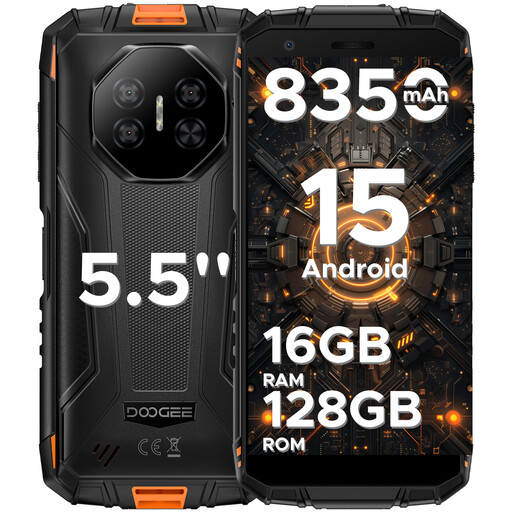
DOOGEE Fire 3 Pro Android 15 AI Rugged Smartphone
Why it stands out: Built for the most demanding environments, it combines IP68, IP69K, and MIL-STD-810H certifications with a colossal 8350 mAh battery. A true workhorse for tradespeople and construction pros.
It doesn't just rely on promises. Its spec sheet clearly lists the three highest ruggedness certifications, offering verifiable protection against water, dust, and shocks.
Its outstanding battery life, thanks to the 8350 mAh battery and OTG reverse charging function, makes it a reliable partner for lasting several days away from a power outlet.
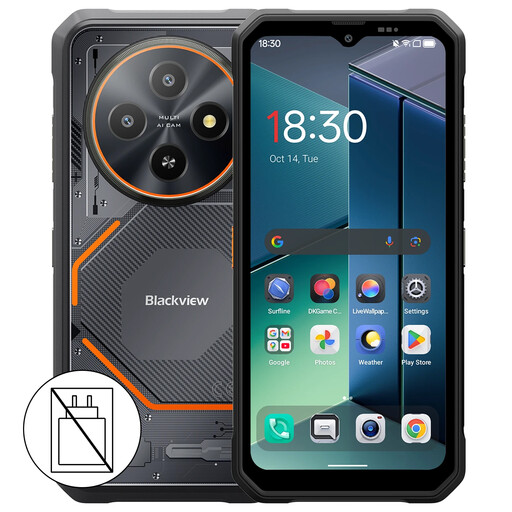
Blackview Fort 2 Android 15 Outdoor 4G Smartphone
Why it stands out: It strikes the perfect balance between certified ruggedness (MIL-STD-810H, IP68/IP69K) and a portable design. Its slimmer, lighter build (245g) makes it ideal for hiking, mountain biking, or trekking, where every gram counts.
It proves that a rugged phone isn't necessarily a brick. It integrates high-level protection into a design that doesn't sacrifice portability.
Its balance of weight, slimness, and certifications. The glove mode and underwater camera are real bonuses for adventurers.
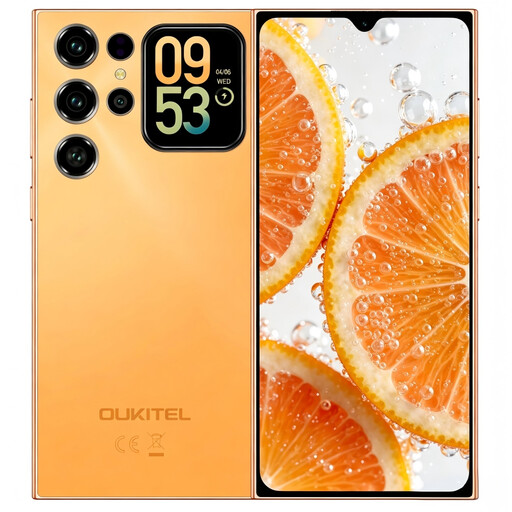
OUKITEL C62 6.88-Inch 5150mAh Battery
Why it stands out: For those seeking a more durable-than-average device without needing extreme specs, this model offers comfortable battery life with its 5150 mAh battery and a large screen, all at an affordable price.
It focuses on the essentials: a good-capacity battery and a large screen in a tougher-than-average design, without the extra cost of military-grade standards.
Its price-to-feature ratio. The addition of a second screen on the back for notifications is a clever feature that's rare at this price point.
Want to explore other options?
Discover our full selection of smartphones that meet our criteria for ruggedness and reliability, all compliant with current standards.
Your Questions About Rugged Smartphones
Is an "?unbreakable?" smartphone truly indestructible?
No. The term is primarily for marketing. These phones are designed to be far more resistant to drops, water, and dust than standard models, as proven by MIL-STD-810H and IP68/IP69K certifications. However, an extreme impact or submersion beyond the specified limits can still damage it. It's about enhanced resistance, not total invulnerability.
What's the actual difference between IP68 and IP69K?
The IP68 rating guarantees protection against prolonged submersion in fresh water (typically up to 1.5m for 30 min). This is perfect for accidental drops into a puddle or a swimming pool. The IP69K rating goes further by ensuring resistance to high-pressure, high-temperature steam cleaning. This is a decisive advantage in industrial, agricultural, or food processing environments where equipment is regularly washed down.
Does a rugged smartphone automatically have better battery life?
Generally, yes. Manufacturers focus on longevity by integrating very large-capacity batteries. But be careful not to rely solely on the mAh number. A 6000 mAh model with perfectly optimised software can prove more durable than another one showing 7000 mAh but whose system is an energy drain. You need to look at the whole package:?battery capacity, processor efficiency, and software optimisation.