
2026 Guide: How to Choose Your Smart HEPA Air Purifier?
With an ever-growing market, selecting the right air purifier for your needs can seem complex. Between technical specifications and marketing promises, it's essential to focus on objective criteria to make an informed choice. As a Product Recommendation Officer at Joybuy, my role is to provide you with clear guidelines to help you identify the device that will truly meet your expectations, whether it's to combat allergies, odours, or simply to breathe healthier air every day.
Essential Criteria for an Informed Choice
Before comparing models, it's helpful to understand a few key concepts that determine an air purifier's effectiveness.
1. Understanding CADR (Clean Air Delivery Rate)
The CADR (Clean Air Delivery Rate) is a standardised performance metric. Expressed in cubic metres per hour (m³/h), it measures the volume of air filtered by the device in one hour. For optimal efficiency, it is advisable to choose a device with a CADR that matches the size of your room. A simple rule of thumb is to ensure the device can exchange the air in the room at least two to three times per hour. For example, for a 20 m² bedroom with a 2.5 m ceiling height (which is 50 m³), a CADR of at least 100-150 m³/h is a good starting point.
2. The Importance of the H13 HEPA Filter
Filtration technology is the heart of the purifier. A HEPA (High-Efficiency Particulate Air) filter is a standard that guarantees the capture of a very high percentage of fine particles. The H13 designation means the filter can trap at least 99.95% of particles as small as 0.3 microns, which includes pollen, dust mites, pet dander, and some smoke. This is a non-negotiable feature for people with allergies or asthma. Most devices combine this filter with a pre-filter (for large dust particles and hair) and an activated carbon filter to neutralise odours and volatile organic compounds (VOCs).
3. User Convenience: Noise Level and Smart Features
An air purifier is often intended to run continuously, including at night. A quiet air purifier is therefore essential, especially for use in a bedroom or office. Look at the noise level expressed in decibels (dB) in night mode or at the lowest speed. A level below 30 dB is generally considered very discreet.
Smart features, such as Wi-Fi control via an app or compatibility with voice assistants like Alexa, provide added convenience. They allow you to control the device remotely, schedule operating times, or monitor air quality in real time using an integrated PM2.5 sensor.
Our Top Air Purifier Picks for 2026
Here are a few options that stand out for their technical specifications and their suitability for user needs.
Homintell Smart Air Purifier
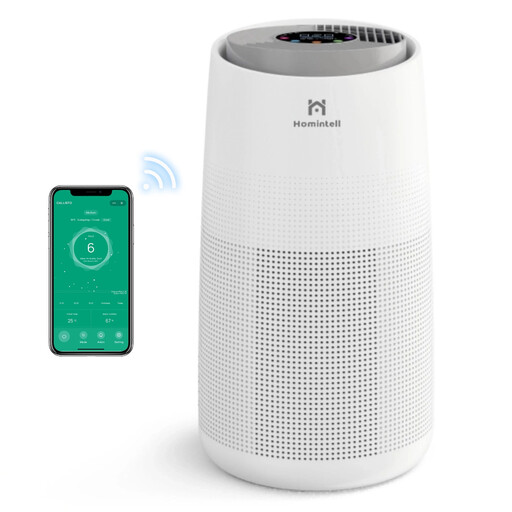
Why we recommend it This model offers an excellent balance of performance and features. With a CADR of 300 m³/h, it is well-sized to effectively purify the air in living spaces up to 36 m². Its triple filtration (pre-filter, H13 HEPA, activated carbon) is enhanced by UV sterilisation and ionisation functions, offering a comprehensive approach to air treatment.
Advantages
- Purification Performance: A high CADR for fast action in medium-sized rooms.
- Comprehensive Filtration: 3-in-1 system with an H13 HEPA filter to capture allergens and activated carbon for odours.
- Smart Features: Wi-Fi control, air quality sensor with colour display, and temperature/humidity indicator.
- Quiet Night Mode: Operates at just 26 dB for undisturbed sleep.
Who is this product for? Ideal for families in urban environments, pet owners looking for a pet odour removal solution, and anyone wanting a high-performance, connected device for a main living area like a living room or a large bedroom.
Jafända Air Purifier for Large Rooms
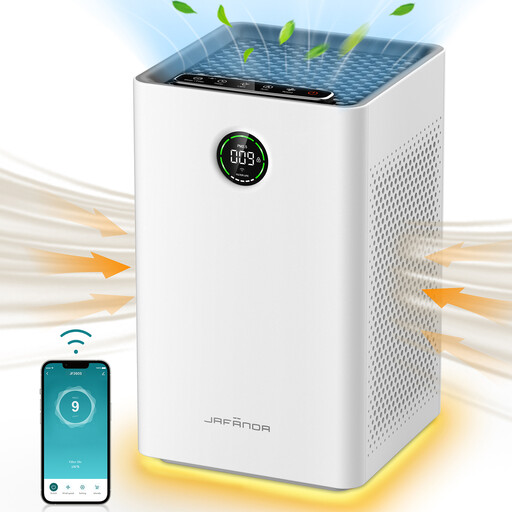
Why we recommend it The Jafända model stands out for its particularly quiet operation and advanced connectivity. Its CADR of 260 m³/h is suitable for rooms up to 24 m² with 5 air changes per hour. The real-time PM2.5 sensor and control via Alexa or Google Assistant make it a highly convenient device for daily use.
Advantages
- Extremely Quiet: Night mode drops to 23 dB, making it nearly inaudible.
- Advanced Connectivity: Full control via the mobile app and voice commands with major assistants.
- Precise Air Quality Monitoring: The PM2.5 sensor displays the real-time particle concentration.
- H13 HEPA Filtration: Effective against dust, pollen, and other allergens.
Who is this product for? Perfect for those seeking a quiet air purifier for a bedroom or office. It's also an excellent choice for smart home enthusiasts who want to integrate their purifier into their connected ecosystem.
TRULIVA Air Purifier
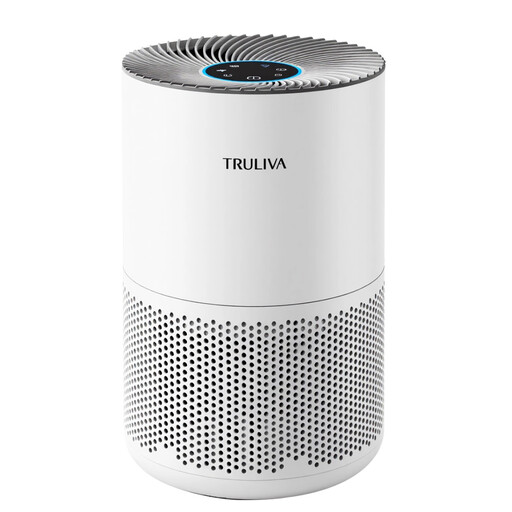
Why we recommend it The TRULIVA purifier delivers solid performance with a CADR of 260 m³/h and a practical approach to maintenance. Its main advantage is its washable filter, which helps reduce long-term replacement costs. Its 24-hour programmable timer offers great flexibility.
Advantages
- Cost-Effective Maintenance: The main filter is washable, which extends its lifespan and reduces waste.
- Discreet Operation: Sleep mode at 24 dB ensures peaceful nights.
- Comprehensive Timer: Programmable from 1 to 24 hours for automated management.
- 3-in-1 H13 HEPA Filtration: Ensures effective capture of 99.97% of fine particles, including allergens like dust mites.
Who is this product for? A very relevant option for users mindful of their long-term budget and environmental impact, thanks to its reusable filter. It is well-suited for medium-sized rooms and for people who prefer simple programming via a direct control panel.
Explore Other Filtration Options
If the models presented don't fully match your criteria, or if you are simply looking for a replacement filter, it may be useful to explore a wider range. You can browse our selection of HEPA air purifier filters to find solutions tailored to different devices and needs.
Frequently Asked Questions (FAQ)
1. Is an air purifier effective against cigarette or pet odours? Yes, provided it is equipped with an activated carbon filter. While the HEPA filter tackles particles (dust, pollen, smoke), the activated carbon is specifically designed to absorb gases, odours, and volatile organic compounds (VOCs). The combination of the two is therefore very effective for pet odour removal or reducing the smell of tobacco smoke.
2. What is the lifespan of a HEPA filter, and when should it be replaced? The lifespan of a HEPA filter typically ranges from 6 months to 2 years, depending on the model, frequency of use, and the level of air pollution. Most modern smart air purifiers are equipped with an indicator light or an in-app notification that automatically alerts you when it's time to replace the filter. For models like the TRULIVA, the washable filter can have an extended lifespan if maintained regularly.
3. Does a smart air purifier use a lot of electricity? No, power consumption is generally moderate. Most recent devices, like the ones featured, have a rated power between 25W and 35W. When operating at low speed or in automatic mode, consumption is even lower. This represents a very limited energy cost, even for near-continuous operation.