
USB-C Cable Buyer’s Guide: Avoid Pitfalls and Choose the Right One
A USB-C cable that won't charge, frays after a few weeks, or transfers data at a snail's pace: it's a frustrating experience many of us have had. With an overwhelming number of options on the market, it's easy to get lost in marketing claims that often hide a much less impressive reality. As a Product Specialist at Joybuy, my job is to help you see things more clearly.
Forget the flashy packaging; let's focus on the facts. Here are the three most common pitfalls when buying a USB-C cable and, more importantly, how to avoid them.
- The "Fast Charging" Illusion: Many cables advertise this feature without being compatible with Power Delivery (PD) technology, which is essential for efficiently powering a laptop like a MacBook or even an iPhone 16. An unsuitable cable will limit the power output, even with a high-performance charger.
- Built-in Fragility: The weak point is almost always the same: the joint between the connector and the cable. Low-end models use a rigid plastic sheath that cracks after a few bends, leaving the wires exposed and rendering the cable useless, or even dangerous.
- Slow Data Transfers: You think you're buying a cable to quickly sync your files, but transferring your holiday photos takes all evening? Most standard charging cables are limited to the USB 2.0 standard (480 Mbps), light-years away from the speeds promised by USB 3.x or 4.
The 3 Criteria to Check Before You Buy
To make the right choice, you only need to check three technical specifications. They are the true measure of your USB-C cable's performance, durability, and safety.
1. Charging Power (in Watts) and Power Delivery Standard
Power, measured in watts (W), is the number one criterion for a fast-charging cable. It must be suited to the device you intend to power.
- Up to 60W: This is the standard power level, sufficient for fast charging most smartphones (including the iPhone 16), tablets, and ultra-portable laptops.
- 100W and above: Essential for efficiently powering and recharging most laptops, such as MacBook Pros, which require high wattage.
- 240W: This new standard (EPR for Extended Power Range) is designed for the most power-hungry devices, like mobile workstations or gaming laptops.
Key point to watch for: Ensure the cable explicitly mentions its Power Delivery (PD) compatibility. Without it, the charging power will be throttled, regardless of your charger's performance.
2. Materials and Design: The Key to Durability
A cable is an everyday object, constantly handled and put to the test. Its lifespan depends directly on its build quality.
- The outer sheath: A braided USB-C cable made of nylon (or recycled materials) offers far better resistance to abrasion and tangling than a standard PVC jacket.
- Connector reinforcement: Look at the base of the connectors. A flexible, elongated strain relief is crucial: it absorbs stress during bends and prevents breakage, the Achilles' heel of most cables. Some manufacturers provide objective data, such as a tested resistance to over 10,000 or 30,000 bends.
- USB-IF certification: A cable certified by the USB Implementers Forum guarantees that it meets strict safety and performance standards. It's a mark of reliability that protects your valuable devices from overvoltage or short circuits.
3. Length and Practicality
The ideal length depends on your usage habits.
- 1 metre: Perfect for on-the-go use, with a power bank, or in the car. Easy to store and take anywhere.
- A 2m USB-C cable: Very practical at home or in the office, allowing you to use your device comfortably even when the socket is far from your sofa or desk.
Our Top USB-C Cable Picks
Here is our selection, based on the objective criteria we've just discussed, to meet specific needs.
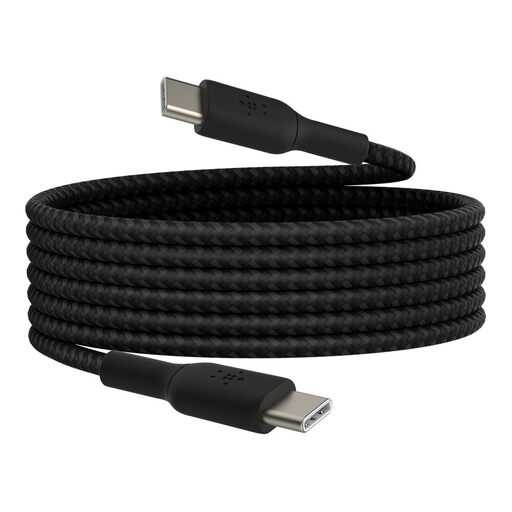
Belkin BoostCharge Braided USB-C to USB-C Cable 2m Black
Why we chose it: This is the peace-of-mind choice for intensive daily use, both at home and in the office. Its 2-metre length offers excellent flexibility, and its robust design is built to last.
It avoids the fragility pitfall with its braided nylon sheath, tested to withstand over 30,000 bends, and its reinforced connectors.
USB-IF certification guarantees maximum compatibility and safety with all your USB-C devices. Its 2-metre length is a real daily convenience.
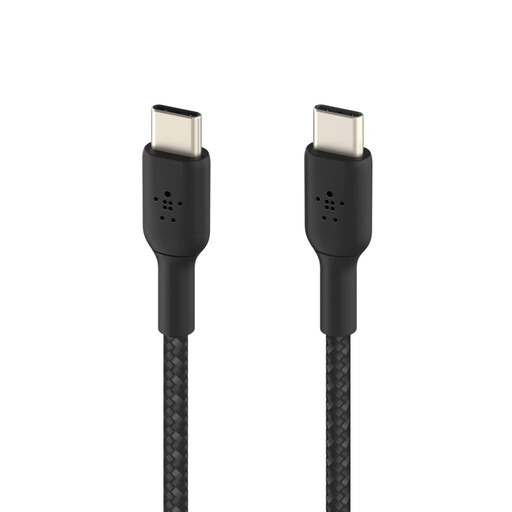
Belkin Braided USB-C to USB-C Cable 1m - Black
Why we chose it: Perfect for travel, this 1-metre cable combines fast charging and durability in a compact form factor. The detail that makes the difference: the included strap to keep it neatly coiled in your bag.
It avoids the "slow charging" pitfall by clearly supporting 60W of power via Power Delivery, ideal for quickly recharging a smartphone or tablet on the go.
Its durable design incorporates 95% recycled plastic, combining performance with a more eco-friendly approach.
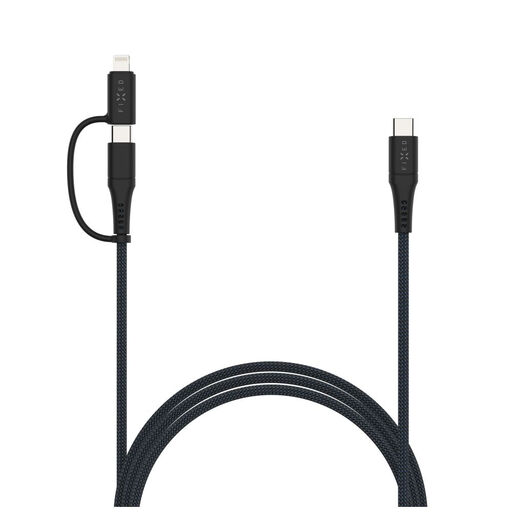
FIXED Braided USB-C to USB-C Cable with Lightning Adapter, 2m
Why we chose it: The perfect solution for those who juggle devices between the Apple ecosystem (older iPhones/iPads) and Android devices or modern computers. One cable to rule them all.
It ends the compatibility headache and the need to carry multiple cables. The Lightning adapter is MFi (Made for iPhone) certified, which guarantees flawless performance.
Its 2-in-1 versatility is its key advantage. The 2-metre length and braided sheath make it a practical and durable companion for any situation.
Looking for other models?
Discover our complete, up-to-date selection of products that meet our strict selection criteria and European safety standards.
Frequently Asked Questions
What power rating should I choose for my USB-C cable: 60W, 100W, or 240W?
It all depends on your most power-hungry device. A 60W cable is sufficient for smartphones, tablets, and small ultra-portable laptops. For a MacBook Pro or another powerful laptop, a 100W or higher model is recommended to ensure full-speed charging. A 240W cable is a future-proof option, ready for the most demanding current and future devices.
Is a braided USB-C cable really more durable?
Yes, in the vast majority of cases. The braided sheath, often made of nylon, protects the cable much better against fraying, cuts, and tangles than a standard plastic (PVC) jacket. However, be aware that the overall quality also depends on the reinforcement at the connectors. A braided USB-C cable with well-reinforced connectors is an excellent long-term investment.
Will this type of cable work with my iPhone 16 or MacBook?
Yes. Since the iPhone 15, Apple has adopted the USB-C port. Therefore, any quality USB-C to USB-C cable will be compatible. For a MacBook, which has used USB-C for years, the crucial point is to choose a cable that supports the Power Delivery standard with sufficient wattage (usually 60W or more) to ensure efficient charging. USB-IF certification is a significant bonus for optimal safety.