
Wireless Lavalier Microphone Buying Guide: How to Choose the Right One
Great video is one thing, but poor audio can single-handedly ruin an entire production. Whether you're a content creator, journalist, or simply want the best quality for your recordings, the wireless lavalier microphone is the essential tool for capturing a clear, intelligible voice. The problem is, the market is flooded with models and marketing promises that too often lead to buyer's remorse.
As the head of product selection at Joybuy, my role is to help you navigate this jungle. To save you from any unpleasant surprises, here are the common pitfalls to avoid and the key criteria for making the right choice.
The 3 Pitfalls to Avoid Before Buying a Lavalier Mic
Too many users end up with unsuitable equipment. Here are the classic mistakes and our advice on how to avoid them.
- The Myth of Universal Compatibility: Many microphones are marketed as "compatible with all devices." In reality, compatibility is rarely absolute. Many models require specific (and often expensive) adapters or suffer from degraded performance on certain systems. A wireless smartphone microphone designed for Android won't necessarily deliver the same performance on an iPhone, and vice versa.
- "Magical" Noise Reduction That Distorts Your Voice: A noise-cancelling microphone with an overly aggressive feature might seem appealing, but it's often poorly calibrated. Instead of just filtering out background noise, it compresses and alters the vocal timbre, giving it a metallic and unnatural sound. This is a deal-breaker for an interview or a podcast.
- Advertised vs. Real-World Battery Life: Spec sheets often display highly optimistic figures measured under lab conditions. For a vlogging microphone used outdoors or for long sessions, a battery that dies prematurely is a total nightmare, capable of sabotaging a recording mid-session.
Key Technical Specs for High-Quality Sound
To avoid being misled, rely on these objective technical specifications. They are the real deciding factors.
1. Connectivity: The Key to Flawless Compatibility
First and foremost, identify the port on your primary device.
- USB-C: This is the current standard for most Android smartphones, newer iPhone models (from the iPhone 15 onwards), tablets, and laptops. A receiver with a native USB-C microphone connector ensures a direct, stable, and latency-free connection.
- Lightning: If you own an iPhone 14 or an earlier model, a receiver with a Lightning connector is essential to avoid using adapters, which are often fragile and unreliable.
- 3.5mm Jack (TRS/TRRS): This connector is mainly intended for cameras (DSLRs, mirrorless) and some computers. Make sure the included cable is compatible (TRS for cameras, TRRS for smartphones that still have a jack).
2. Noise Reduction Technology: DSP vs. AI
The clarity of your voice depends directly on how the microphone handles background noise.
- DSP (Digital Signal Processor): This technology uses a dedicated chip to filter specific sound frequencies (wind, traffic, air conditioning). It is often more predictable and better preserves the natural vocal timbre. Some models offer multiple reduction levels to adapt to the environment.
- AI-Powered Noise Reduction: A more recent approach, this uses algorithms to distinguish the human voice from other sounds. It can be very effective, but entry-level models are sometimes overly aggressive and produce a slightly metallic vocal quality.
3. Battery Life and the Charging Case
For on-the-go use, battery life is a non-negotiable feature. A good wireless mic kit should include a charging case. This case isn't just for storage; it recharges the transmitters and receiver between uses, significantly extending the total battery life. Check the battery life of a single transmitter (at least 5-6 hours is a good baseline) and the total battery life provided by the case (15-20 hours offers a comfortable buffer for a full day of shooting).
Recommended Wireless Lavalier Microphones
Here is a selection of models that check all the boxes, designed for different user profiles.
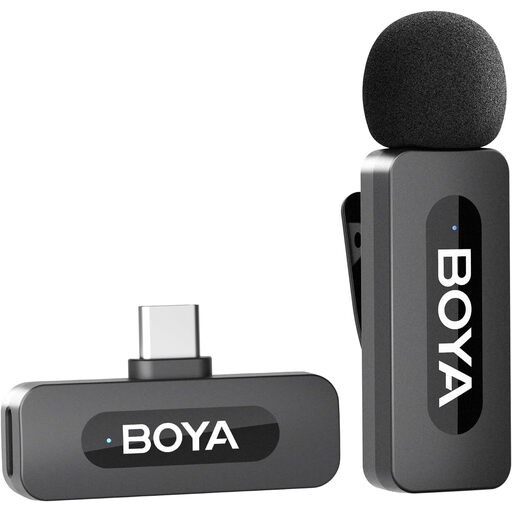
BOYA BY-V10 V2.0 USB-C Wireless Microphone
Profile: Ideal for vloggers and creators on TikTok or Instagram looking for a simple, effective solution. It plugs directly into a USB-C smartphone for immediate, out-of-the-box use without complex setup.
Its native USB-C connection eliminates the compatibility trap and the need for fragile adapters. It's a reliable plug-and-play solution for modern devices.
Simplicity is its strong suit: one-click noise reduction and 9 hours of battery life, perfect for most vlogging sessions.
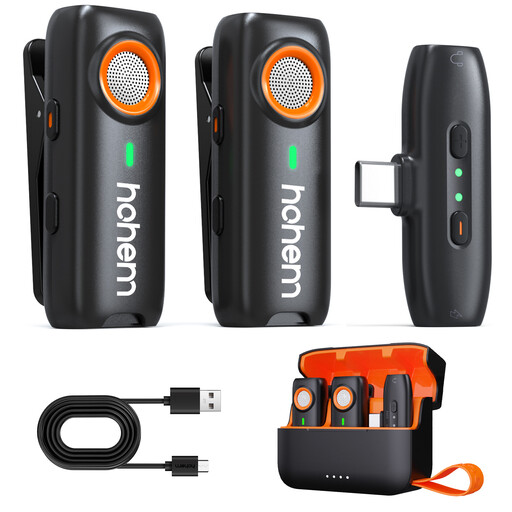
hohem Wireless Lavalier Microphone, 3-Level DSP Noise Cancelling
Profile: Designed for demanding users who often record outdoors. Its long range, extended battery life, and backup recording feature make it a trusted ally in the field for journalists and documentarians.
It guards against data loss with its TF card slot, which provides local backup recording. The total 20-hour battery life (with the case) is a realistic and comfortable figure for long shooting days.
The backup recording on a TF card is a true fail-safe. The 3-level DSP noise reduction allows for fine-tuning the audio filtering without distorting the voice.
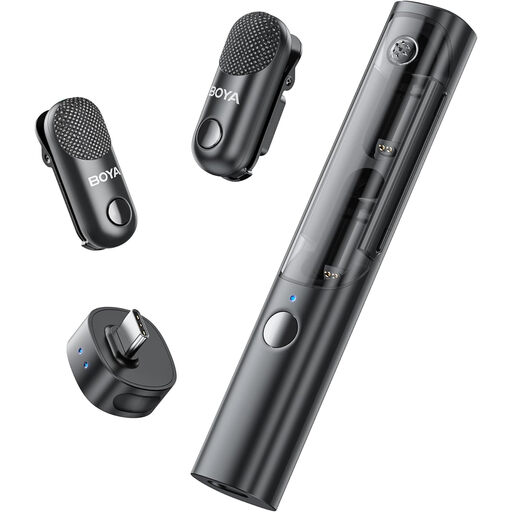
BOYA Magic-05 USB-C Al-Powered Transformable Wireless Microphone
Profile: This dual-transmitter kit is perfect for interviews, two-person podcasts, or online courses. It's aimed at those seeking audio quality that's a cut above and maximum versatility.
Unlike entry-level kits, it includes two transmitters (2 TX) by default, making it immediately ready for interviews. Its AI-powered noise reduction is calibrated to be effective without making the audio sound artificial.
The dual-transmitter kit is its number one selling point. Its wide compatibility (camera, smartphone, computer) makes it a versatile solution that can adapt to various shooting scenarios.
Looking for more options?
We have curated a complete and up-to-date selection of microphones that meet our selection criteria and European safety standards.
Frequently Asked Questions (FAQ)
1. How do I connect a wireless lavalier mic to a recent iPhone (15 or newer)? iPhone 15 and later models are equipped with a USB-C port. Simply choose a wireless mic kit with a receiver that has a native USB-C plug. Plug it directly into the iPhone's port, and it will be automatically recognized by the system, with no app or configuration required.
2. Does noise reduction always degrade voice quality? No, not always. A well-designed noise reduction technology, like a multi-level DSP, can target background noise without distorting the vocal timbre. It's recommended to disable this function in a quiet environment (like a studio) and activate it at a moderate level outdoors to find the right balance.
3. What is the real-world battery life of a wireless mic kit with a charging case? Battery life depends on usage. A single transmitter typically provides 5 to 9 hours of continuous recording. The charging case allows you to recharge the components multiple times. For example, a kit with a total battery life of 20 hours means you can use and recharge the transmitters to reach that cumulative duration, which is more than enough for a full day of intermittent shooting.