
Choosing the Right Wireless Microphone and Avoiding Common Pitfalls
For content creators, vloggers, and videographers, the verdict is in: flawless audio quality isn't an option—it's a prerequisite. Clear, crisp sound is what separates an amateur video from a professional-grade production. But the wireless microphone market is a jungle, and it's easy to get lost in a maze of technical specifications.
As your lead audio editor, my job is to guide you through this technological maze. Together, let's break down the features that truly matter for a wireless lavalier microphone and learn how to spot the pitfalls before you make a purchase.
The 3 Pitfalls to Avoid When Buying a Wireless Microphone
Marketing is an art, and sometimes it's the art of illusion. Some brands don't hesitate to oversell features that, in practice, turn out to be disappointing. Here are three critical things to watch out for before making your choice.
- Unrealistic Battery Life: Beware of impressive-sounding numbers. Many manufacturers advertise a maximum battery life calculated under lab conditions, often for just a single component (like the transmitter). In the real world, once the receiver is on and connections are active, that duration melts away, risking a dead battery in the middle of a shoot.
- The False "Plug-and-Play" Promise: You're sold a solution that's "ready to use," but unboxing it is a rude awakening. The essential adapter is missing, you have to download an obscure app, or you're forced into endless configuration just to get the mic to work with your smartphone or camera.
- Distorting Noise Reduction: To mask a poor-quality microphone capsule, some models apply noise reduction that is so aggressive it becomes counterproductive. The voice loses its natural tone, sounding metallic, compressed, or even robotic. In the end, the cure is worse than the disease.
The Features That Are True Game-Changers
To make the right choice, it's best to focus on the key technical specifications that guarantee both quality and versatility.
32-Bit Float Internal Recording: Your Safety Net
This is THE technical feature that changes everything. Picture this: you're recording an interview, and your subject suddenly bursts out laughing or raises their voice. With a standard microphone, the audio is guaranteed to clip, leaving you with ruined audio that's impossible to fix in post-production.
In contrast, a 32-bit float recorder microphone captures such a vast dynamic range that it's virtually impossible to clip the signal. Even with unexpected sound peaks, you have a raw audio file that you can easily adjust in post-production without any distortion. It's a complete safety net for any serious project.
Compatibility and Ecosystem: Beyond Just the Receiver
The true versatility of a vlogging or interview mic isn't measured by the number of adapters in the box, but by its ability to integrate seamlessly with your gear. Some ecosystems, like DJI's, excel at this by enabling direct connections to compatible devices.
For example, being able to connect a transmitter directly to a DJI Osmo Action via Bluetooth, without using the receiver, radically simplifies your setup and reduces potential points of failure. So, check if the microphone offers a direct connection (Bluetooth or a proprietary protocol) in addition to the standard adapters for a camera or smartphone.
Recommended Wireless Microphones
Rather than an endless list, we've selected a few standout models and matched them with specific user profiles. The goal is to help you find the microphone that truly fits your needs.
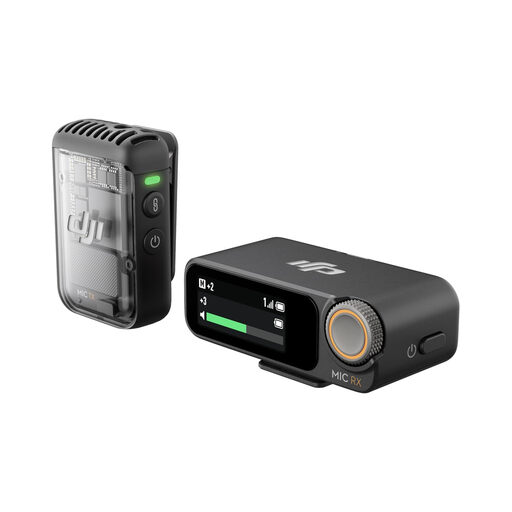
DJI Mic 2 (1 TX + 1 RX), Wireless Microphone with Intelligent Noise Cancelling
The ideal user: Perfect for vloggers, online trainers, or videographers who work alone. Its compact size, stunning simplicity, and reliability make it the ideal tool for capturing flawless audio without needing an assistant.
The internal 32-bit float recording is your anti-clipping insurance. The intelligent noise reduction works brilliantly without making your voice sound robotic. The included USB-C and Lightning adapters ensure true plug-and-play compatibility.
Crystal-clear, professional audio quality. Stable range up to 250 m (in open environments). Direct Bluetooth connection possible with DJI ecosystem products like the Osmo Pocket 3 or Osmo Action 4.
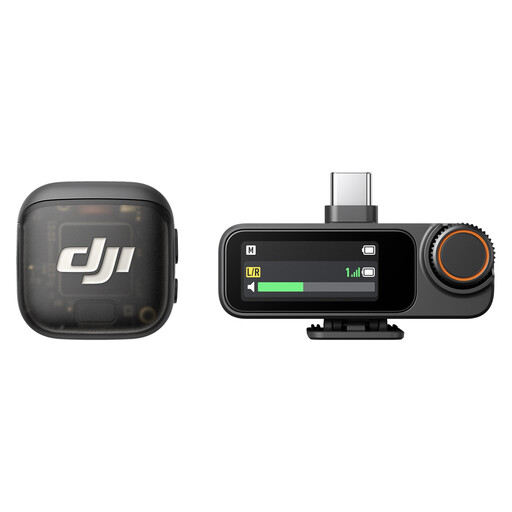
DJI Mic 2 (2 TX + 1 RX) + Charging Case
The ideal user: Tailor-made for situations with multiple speakers: interviews, podcasts, panel discussions, and more. The two transmitters allow you to capture two separate sound sources simultaneously on a single receiver.
The charging case puts an end to battery anxiety. It allows you to recharge all components on the go, ensuring you can last a full day of shooting. The system is designed for perfect management of both transmitters.
Records on two separate channels. Massive battery life thanks to the case. The system includes robust anti-interference technology and can manage the levels of each microphone independently.
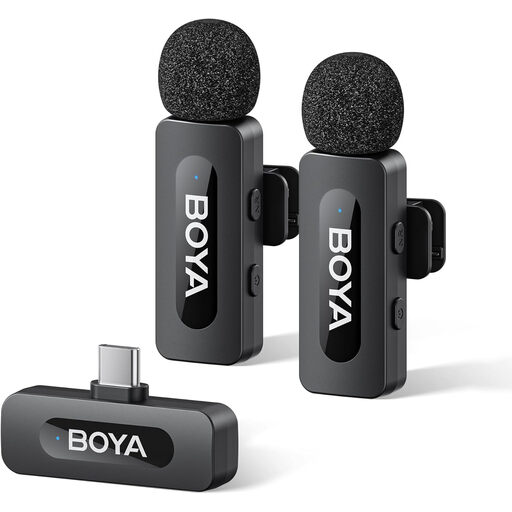
BOYA BY-V20 V2.0 USB-C Wireless Microphone (2 TX+1 RX)
The ideal user: A highly accessible entry point for getting started with content creation on a smartphone (Android or recent iPhones with USB-C). Ideal for recording two people without breaking the bank.
This kit bypasses the compatibility hurdle by offering a receiver that plugs directly into the smartphone's USB-C port. Zero adapters, zero hassle: just plug it in, and it works.
Excellent value for a kit with two transmitters. Incredibly simple thanks to the direct USB-C connection. Noise reduction can be activated with a single press.
Looking for other great finds?
Discover our complete selection of microphones that meet our quality standards and industry regulations.
Frequently Asked Questions (FAQ)
1. What is the real-world battery life of the DJI Mic 2 in continuous use? Each transmitter and the receiver of the DJI Mic 2 last up to 6 hours. But the real game-changer is the charging case (included in the full kit), which extends the total battery life to 18 hours. In short, you can shoot for an entire day without worrying about finding an outlet.
2. Is 32-bit float recording really useful for a beginner? Yes, and it's actually a major advantage for beginners! Not having to stress about setting audio gain levels before recording is a luxury. 32-bit float acts as a true safeguard: even if your subject starts shouting, the audio won't clip. You gain invaluable peace of mind and the certainty that your sound recording will always be perfect for editing.
3. How do I connect the DJI Mic 2 to a smartphone? It's incredibly simple. The DJI Mic 2 receiver comes with two small magnetic adapters: one USB-C (for Android smartphones and the latest iPhones) and one Lightning (for older iPhones). Just clip the correct adapter onto the receiver, plug it into your phone, and it pairs with the transmitter instantly.